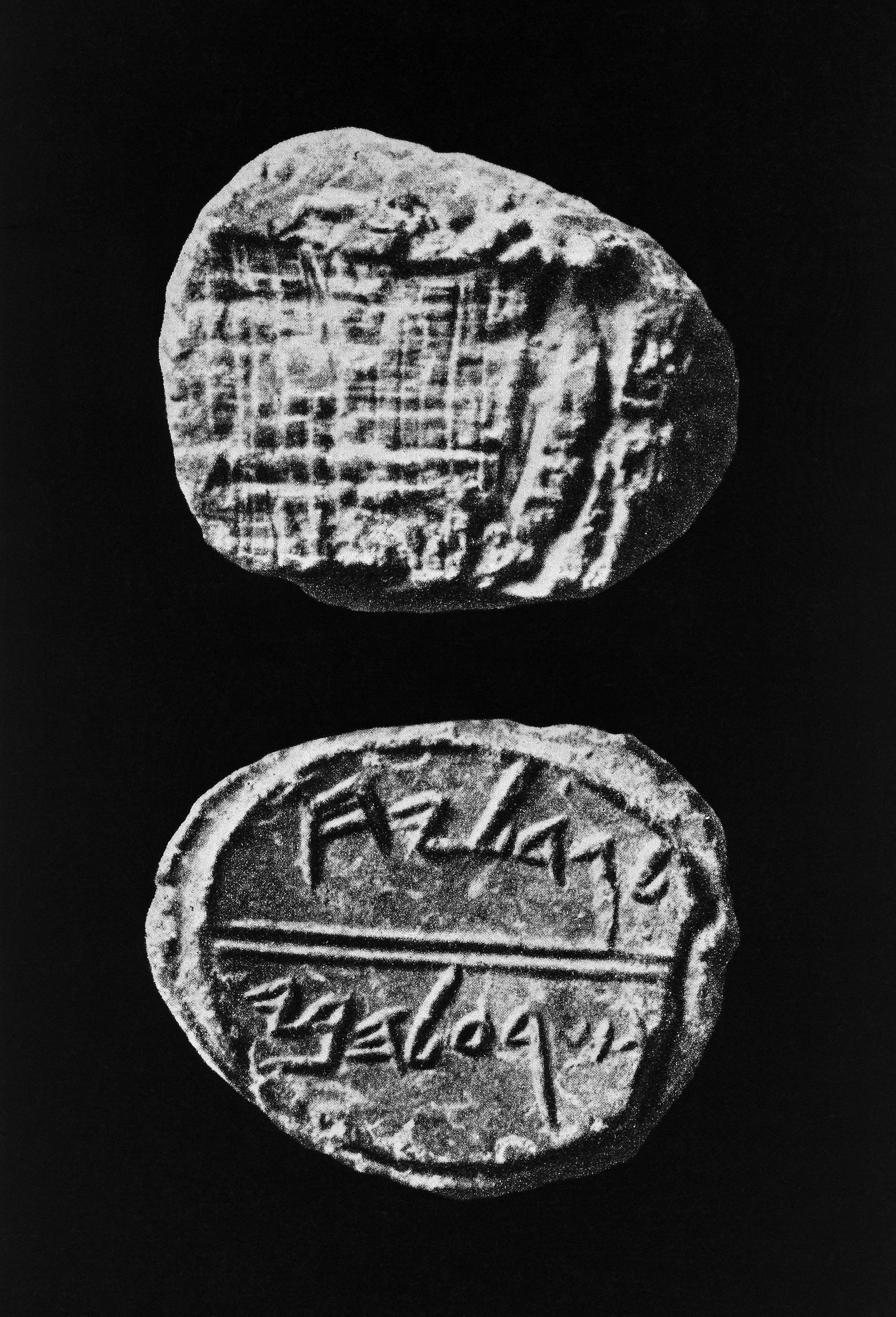
The seal impression bearing the inscription 'belonging to Gedalyahu, who is over the house' (l-gdlyhu ʾšr ʿl hbyt) was identified in the early twentieth century as part of the broader corpus of late-Iron Age Hebrew bullae. The artifact entered scholarly discussion primarily through Nahman Avigad's systematic study of Hebrew seals and bullae, published in his foundational 1986 catalogue. The bulla is held within the Israel Antiquities Authority collection and has been displayed at the Israel Museum in Jerusalem. Like many privately excavated seal impressions of this period, its precise archaeological provenience is not fully documented, a limitation common to objects that entered collections before controlled excavation became standard practice. The bulla is a small fired clay impression, typical of administrative documents sealed with a personal stamp in the late seventh and early sixth centuries BC. The two-line Hebrew inscription employs a paleo-Hebrew script consistent with the late monarchic period and includes the title ʾšr ʿl hbyt, conventionally translated 'who is over the house' or 'steward of the palace,' a well-attested designation for senior royal administrators in the ancient Near East. The dimensions conform to the standard bulla format of roughly 1.5–2 cm. The title and name together reflect the administrative apparatus of the late Judean court in the period preceding the Babylonian destruction of Jerusalem in 586 BC. For biblical scholarship, the seal illuminates the administrative reality underlying references to Gedaliah ben Ahikam ben Shaphan in 2 Kings 25 and Jeremiah 40–41. Ahikam's family held prominent positions in the Josianic and late-monarchic court, and the title ʾšr ʿl hbyt corresponds to a recognized office attested elsewhere in the Hebrew Bible and in comparative Syro-Palestinian epigraphy. The artifact thus contextualizes the political structures within which the biblical narrative of the post-destruction Judean governorship operates. **Sources:** Nahman Avigad, *Hebrew Bullae from the Time of Jeremiah* (Israel Exploration Society, 1986); Avigad and Benjamin Sass, *Corpus of West Semitic Stamp Seals* (Israel Academy of Sciences, 1997); 2 Kings 25:22–25; Jeremiah 40:5–16.
This late-monarchic Hebrew seal impression preserves the title 'servant of the king' alongside the name Gedalyahu, offering direct epigraphic attestation of a senior Judean royal official whose name closely corresponds to the biblical governor Gedaliah ben Ahikam, active in the final decades of the Judean monarchy.