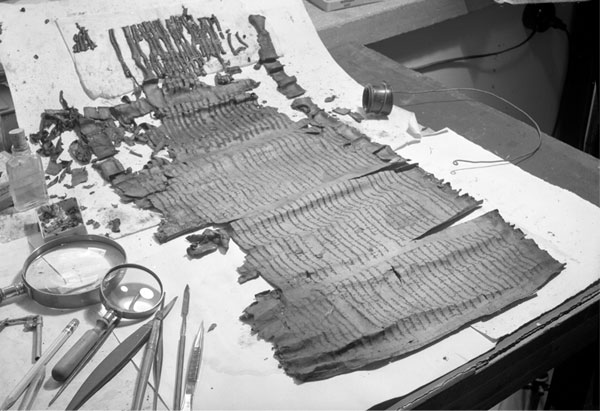
The Genesis Apocryphon was discovered in 1947 among the first cache of scrolls retrieved from Cave 1 at Qumran, near the northwestern shore of the Dead Sea. Bedouin finders initially sold the scroll alongside six others to two separate buyers; it passed to Metropolitan Athanasius Yeshue Samuel and was subsequently acquired in 1954 by Israeli statesman and archaeologist Yigael Yadin on behalf of the Hebrew University. The scroll is now housed at the Shrine of the Book within the Israel Museum, Jerusalem, where it has been held since the institution's opening in 1965. The manuscript is written on leather in a Western Aramaic dialect and, in its surviving form, measures approximately 2.8 meters in length, though the original scroll was considerably longer. Paleographic analysis and radiocarbon dating place its composition or copying between roughly 50 BC and 50 AD, with underlying traditions likely older. The preserved columns (I–XXII) contain narratives corresponding to Genesis 6–15, featuring first-person accounts attributed to Lamech, a section on Noah and the flood, and an extended retelling of Abram's journey to Egypt and Canaan. The Abram section elaborates on the beauty of Sarai (Gen. 12:14–15) through an ekphrastic poem and expands the geography of Abram's tour of the Promised Land beyond what the Hebrew text records. For biblical scholarship, 1QapGen demonstrates that creative, expansive engagement with Genesis was already well established in Jewish scribal circles by the late Second Temple period. It attests to Aramaic as a living literary medium for scriptural interpretation, provides comparative material for understanding targum traditions, and illuminates how figures such as Noah and Abram were elaborated in ways that anticipate later midrashic literature. The scroll remains a principal reference point in the study of rewritten scripture and early Jewish hermeneutics. **Sources:** Avigad, N. and Yadin, Y., *A Genesis Apocryphon* (Magnes Press, 1956); Fitzmyer, J. A., *The Genesis Apocryphon of Qumran Cave 1: A Commentary*, 3rd ed. (Pontifical Biblical Institute, 2004); Machiela, D. A., *The Dead Sea Genesis Apocryphon: A New Text and Translation* (Brill, 2009); Genesis 12:1–20.
The Genesis Apocryphon preserves the earliest known extended Aramaic retelling of patriarchal narratives, revealing how Second Temple scribes interpreted, expanded, and transmitted the book of Genesis roughly two centuries before the common era.