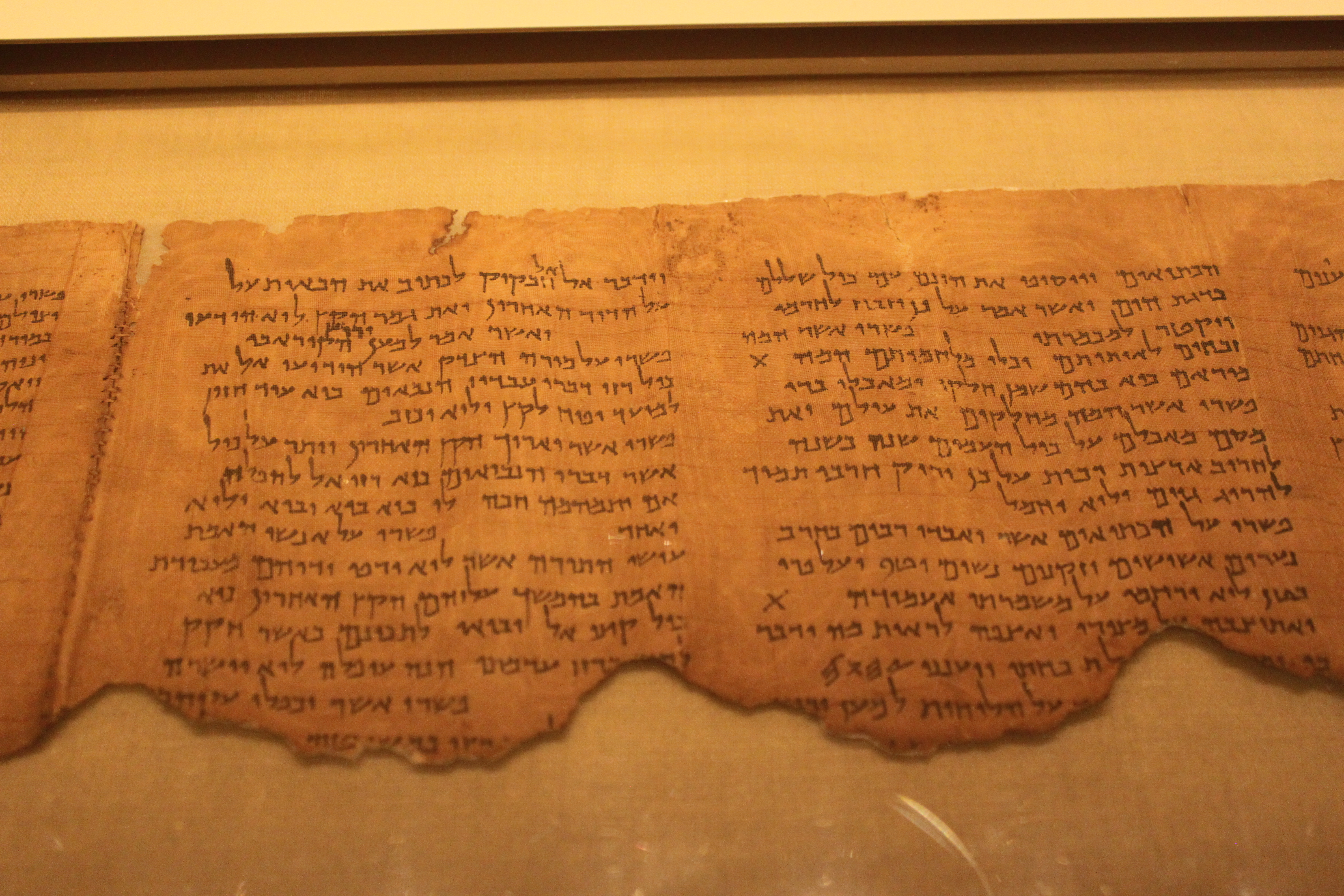
The Habakkuk Pesher (1QpHab) was discovered in Cave 1 at Khirbet Qumran in early 1947 by Bedouin shepherds of the Ta'amireh tribe, alongside six other major scrolls. The cache was subsequently examined by metropolitan Athanasius Samuel of St. Mark's Monastery, Jerusalem, and scholars at the Hebrew University, including Eleazar Sukenik, who recognized the material's antiquity. After complex transactions, the scrolls were acquired for the State of Israel and are now housed in the Shrine of the Book at the Israel Museum, Jerusalem. Palaeographic and radiocarbon analyses, conducted in the 1990s as part of the Accelerator Mass Spectrometry dating program, place the manuscript's composition between approximately 75 and 25 BC. The scroll is written in Hebrew on prepared leather, measuring roughly 1.35 meters in length and preserving thirteen columns of text. It covers Habakkuk chapters 1 and 2, omitting chapter 3, and follows a consistent pesher format: a lemma of biblical text is cited, then immediately followed by the interpretive formula pishro ('its interpretation is'), which applies the verse to figures and events known to the Qumran community. Key figures invoked include the Teacher of Righteousness, the Wicked Priest, and the Kittim—widely identified by scholars as Romans—though precise historical identifications remain debated at the margins. The text engages especially with Habakkuk 2:4, the declaration that 'the righteous shall live by his faithfulness,' applying it to communal Torah observance. For biblical scholarship, 1QpHab is foundational in three respects. First, it attests a proto-Masoretic Hebrew text of Habakkuk alongside minor variants, informing text-critical study of the Minor Prophets. Second, it exemplifies the pesher genre, a form of contemporizing exegesis distinct from both targumic paraphrase and later midrashic elaboration, providing comparative context for interpretive techniques visible in the New Testament. Third, it documents how eschatological expectation shaped scriptural reading within Second Temple Judaism. The scroll remains a primary reference in Qumran studies and Dead Sea Scrolls scholarship internationally. **Sources:** William H. Brownlee, *The Midrash Pesher of Habakkuk* (Scholars Press, 1979); Maurya P. Horgan, *Pesharim: Qumran Interpretations of Biblical Books* (Catholic Biblical Association, 1979); Emanuel Tov, *Textual Criticism of the Hebrew Bible*, 3rd ed. (Fortress Press, 2012); Habakkuk 1:1–2:20.
1QpHab is the earliest surviving example of continuous biblical commentary, demonstrating how a Jewish sect in the late Second Temple period read prophetic scripture as directly encoding events of their own community's history, illuminating interpretive methods foundational to later biblical exegesis.