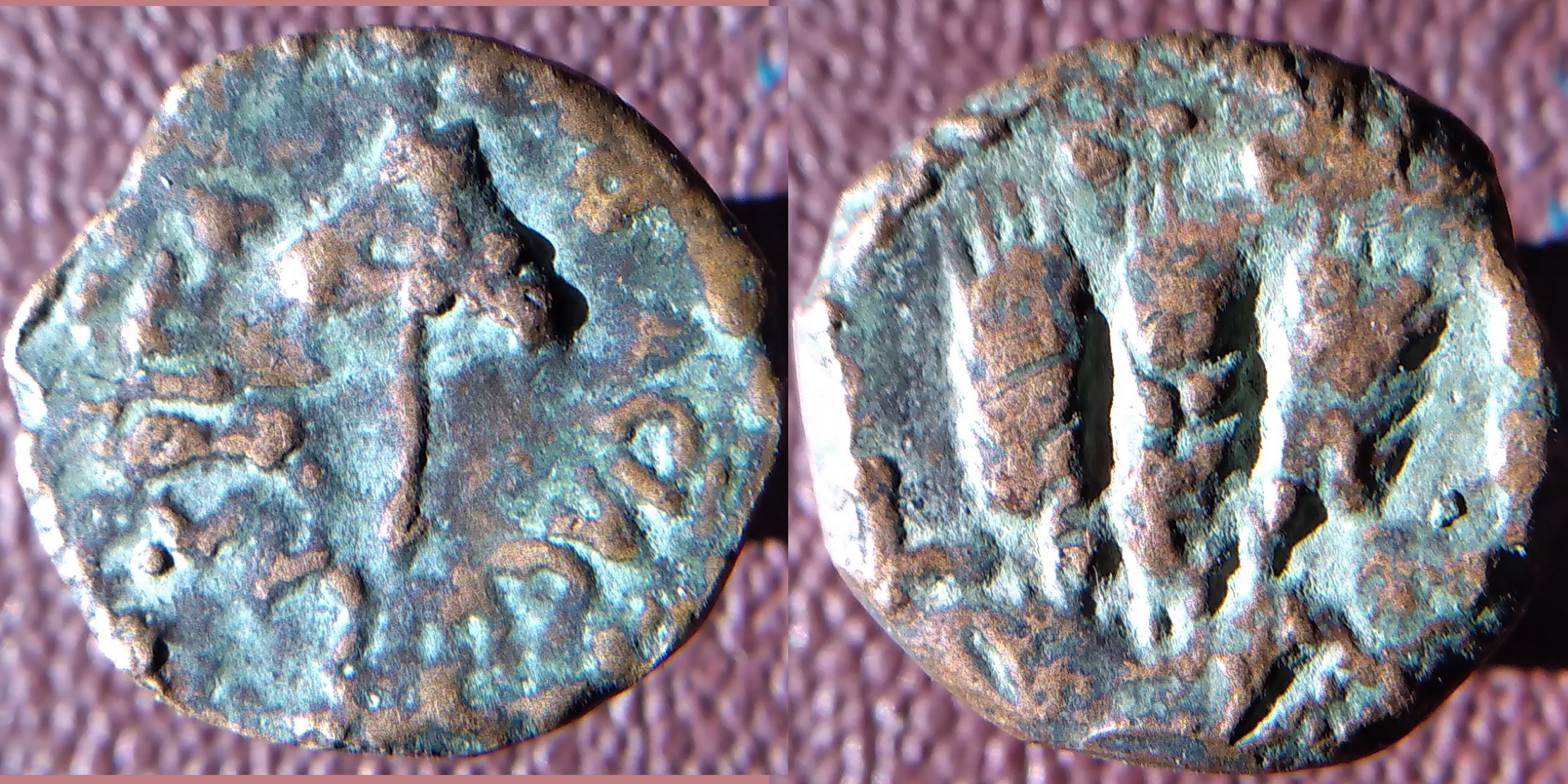
The prutah of Herod Agrippa I is a small bronze coin struck at Jerusalem between AD 41 and AD 44, during the reign of the last Herodian ruler to govern a united Judaea under Roman patronage. The obverse typically displays a royal umbrella-canopy (parasol), a symbol of Hellenistic and Near Eastern kingship, flanked by the Greek inscription BAΣIΛEΩΣ AΓPIΠA ('of King Agrippa'). The reverse bears three barley ears arranged in a bundle, imagery drawn from the agricultural economy of the region and carefully avoiding the human or divine figural representations that would have offended Jewish sensibilities. The coin's denomination, the prutah, was the smallest unit in circulation and circulated widely among ordinary Judaean inhabitants. Numerous examples have been recovered from excavations throughout Jerusalem, Caesarea Maritima, and other Judaean sites, establishing a secure archaeological context for Agrippa's reign. Agrippa I appears in Acts 12 as the king who executed the apostle James son of Zebedee and imprisoned Peter, placing these events squarely within his documented reign of AD 41–44. Acts 12:20–23 further describes his death at Caesarea, attributed to divine judgment—an account that finds a rough parallel in Josephus's account in Antiquities 19.8.2, though the two narratives emphasize different details. The coin does not corroborate the specific episodes in Acts, but it materially confirms Agrippa's royal title, the Jerusalem-centered nature of his administration, and the historical window during which the Acts narrative is set. Sources: Israel Museum (Jerusalem coin collection); Ya'akov Meshorer, A Treasury of Jewish Coins (2001); Josephus, Antiquities 19; Israel Numismatic Journal.
The prutah of Agrippa I provides direct numismatic attestation of his royal title and Jerusalem-based administration during AD 41–44, anchoring the Acts 12 narrative of his persecution of the early church within a precisely dateable historical and political context.