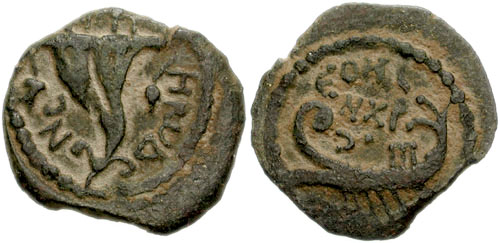
Prutot attributable to Herod Archelaus have been recovered from numerous excavation contexts across Judea, including Jerusalem, Jericho, and sites in the Jordan Valley, with systematic study advancing through the work of numismatists such as Ya'akov Meshorer in the late twentieth century. Meshorer's foundational cataloguing, continued by subsequent scholars including David Hendin, established a typology for these small bronze coins minted during Archelaus's rule from approximately 4 BC to AD 6. Specimens are held in the Israel Museum Jerusalem, the British Museum, the American Numismatic Society in New York, and the Bibliothèque nationale de France, among other institutions. The prutah is a small, low-denomination bronze coin typically measuring 15–17 mm in diameter and weighing roughly 1.5–2.5 grams. Obverse types include a helmet, a double cornucopia, a bunch of grapes, or a prow, while reverse designs often feature an eagle or a wreath enclosing a Greek inscription reading HΡWΔOY EΘNAPXOY ("of Herod the Ethnarch"). Archelaus did not employ his own portrait, consistent with the Herodian dynasty's general avoidance of ruler portraiture on Judean coinage. The titulature "ethnarch" rather than "king" reflects Augustus's deliberate limitation of Archelaus's authority following the division of Herod the Great's kingdom in 4 BC. For biblical study, the Archelaus prutah contextualizes Matthew 2:22, in which Joseph, learning that Archelaus ruled Judea in his father's place, chose to settle instead in Galilee. The coin's ethnarch title corroborates the historicity of that transitional political moment, when Augustus denied Archelaus the royal title his father had held. The eventual Roman deposition of Archelaus in AD 6 and the subsequent establishment of direct prefectural administration over Judea further frame the background against which early Gospel narratives unfold. **Sources:** Ya'akov Meshorer, *A Treasury of Jewish Coins* (Amphora Books, 2001); David Hendin, *Guide to Biblical Coins*, 5th ed. (Amphora Books, 2010); Fabian Udoh, *To Caesar What Is Caesar's: Tribute, Taxes, and Imperial Administration in Early Roman Palestine* (Brown Judaic Studies, 2006); Matthew 2:22.
The Archelaus prutah provides direct numismatic attestation of the ethnarchate that Matthew 2:22 records as the reason Joseph redirected the holy family away from Judea, grounding a pivotal narrative detail in datable archaeological evidence.