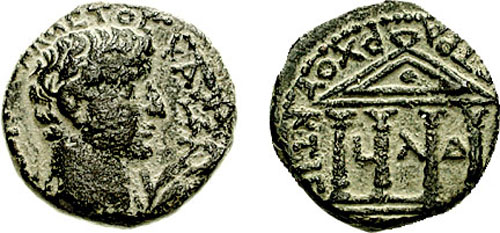
Bronzes of Philip the Tetrarch were struck at his administrative capital Paneas — renamed Caesarea Philippi in honor of Augustus — beginning around AD 1 and continuing through Philip's reign until his death in AD 34. Examples have entered collections through documented excavation and the antiquities market across the nineteenth and twentieth centuries. Significant specimens are catalogued in the British Museum (London) and the Israel Museum (Jerusalem), and they appear in the standard corpus established by Ya'akov Meshorer in his systematic study of ancient Jewish coins published in 2001. The coins are cast in bronze and typically range from 16 to 24 mm in diameter. Their obverse bears a laureate portrait of the reigning Roman emperor — Augustus on earlier issues, Tiberius on later ones — with a surrounding Latin or Greek legend identifying the emperor by title. The reverse commonly depicts a temple façade or the name and regnal year of Philip. This design scheme broke decisively with the aniconic tradition maintained by other Herodian rulers and by the Jerusalem-based Jewish coinage, which avoided human and divine images in deference to Second Temple-period interpretations of the Decalogue. Philip's territory east of the Jordan and north toward Mount Hermon had a predominantly gentile population, which scholars have used to explain the departure from aniconic norms. Luke 3:1 identifies Philip as tetrarch of Ituraea and Trachonitis during the period surrounding John the Baptist's ministry, situating him historically alongside these coins. For biblical studies, the portrait bronzes of Paneas establish the numismatic and political environment of the region where Jesus asks his disciples, at Caesarea Philippi, who people say he is (Matthew 16:13; Mark 8:27). The coins make tangible the imperial cult's visual vocabulary within the tetrarchy and illuminate how Herodian sub-rulers negotiated loyalty to Rome. Meshorer's corpus and subsequent die studies continue to inform scholarly reconstructions of Herodian political economy and the cultural setting of the Synoptic narratives. **Sources:** Ya'akov Meshorer, *A Treasury of Jewish Coins* (Yad Ben-Zvi Press, 2001); David Hendin, *Guide to Biblical Coins*, 5th ed. (Amphora, 2010); Fabian Udoh, *To Caesar What Is Caesar's: Tribute, Taxes, and Imperial Administration in Early Roman Palestine* (Brown Judaic Studies, 2006); Matthew 16:13; Luke 3:1.
As the first coin issued by a Jewish ruler bearing an imperial Roman portrait, Philip's Paneas bronzes illuminate the political and religious boundaries crossed in Herod's divided tetrarchy and provide direct numismatic context for the Caesarea Philippi narratives of the Synoptic Gospels.