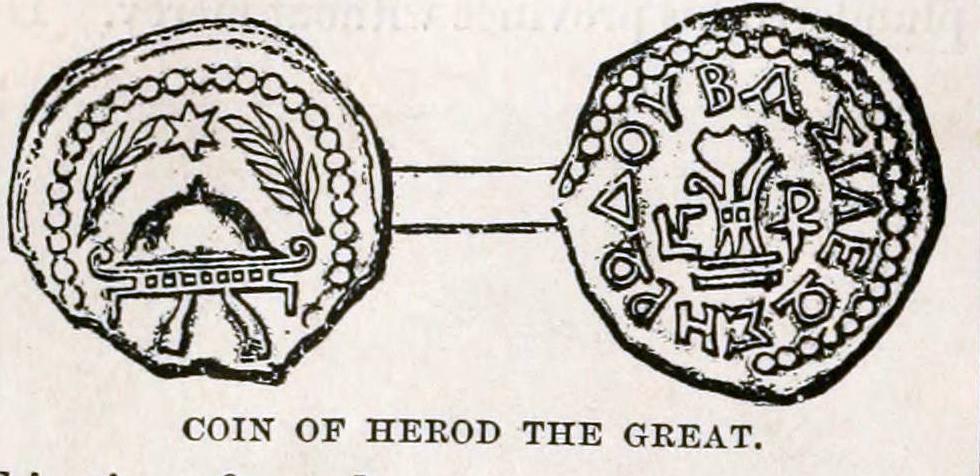
Anchor prutot attributed to Herod I (r. 37–4 BC) have been recovered in substantial quantities across excavations throughout Judea, including at Jericho, Masada, and the Jewish Quarter of Jerusalem. Yaakov Meshorer's systematic study of Hasmonean and Herodian coinage, published across several decades, established the typological sequence and mint attributions for these issues. Specimens are held in the Israel Antiquities Authority numismatic collection at the Israel Museum (Jerusalem), the British Museum (Department of Coins and Medals, catalog series under 'Judaea, Herod I'), and the American Numismatic Society (New York). The prutah is struck in bronze and typically measures 15–17 mm in diameter, weighing approximately 2–3 grams. The obverse bears an anchor — a symbol with both Hellenistic royal and maritime connotations adopted from earlier Hasmonean issues — while the reverse displays a double cornucopia (two horn-shaped vessels of abundance) with a caduceus or pomegranate between them, surrounded by a Greek inscription reading BAΣIΛEΩΣ HPΩΔOY ('of King Herod'). This denomination, the prutah, corresponds to the lepton referenced in New Testament texts: Mark 12:42 explicitly equates two lepta with a kodrantes (quadrans), situating the prutah within the layered Roman-provincial monetary system operative in Herodian Judea. The anchor prutah illuminates the economic texture of the Gospel narratives, confirming that small bronze coinage circulated widely among ordinary inhabitants of Herodian Judea. The coin's iconography — Hellenistic symbols paired with a Greek royal titulature — reflects Herod's deliberate policy of projecting a Greco-Roman identity while avoiding explicitly pagan imagery (no human or divine figures appear), a balance noted by scholars studying Herodian cultural politics. Numismatic density at excavated Herodian-period sites corroborates the New Testament's casual references to the smallest denominations as objects of everyday transaction. **Sources:** Yaakov Meshorer, *A Treasury of Jewish Coins* (Yad Ben-Zvi Press / Amphora Books, 2001); David Hendin, *Guide to Biblical Coins*, 5th ed. (Amphora, 2010); Donald T. Ariel and Jean-Philippe Fontanille, *The Coins of Herod* (Brill, 2012); Mark 12:41–44; Luke 21:1–4.
As the most common bronze denomination struck under Herod I (37–4 BC), the anchor prutah provides direct numismatic evidence for the monetary economy in which Jesus's parables and teachings about small coinage were grounded, anchoring Gospel references to the lepton and prutah in verified material culture.