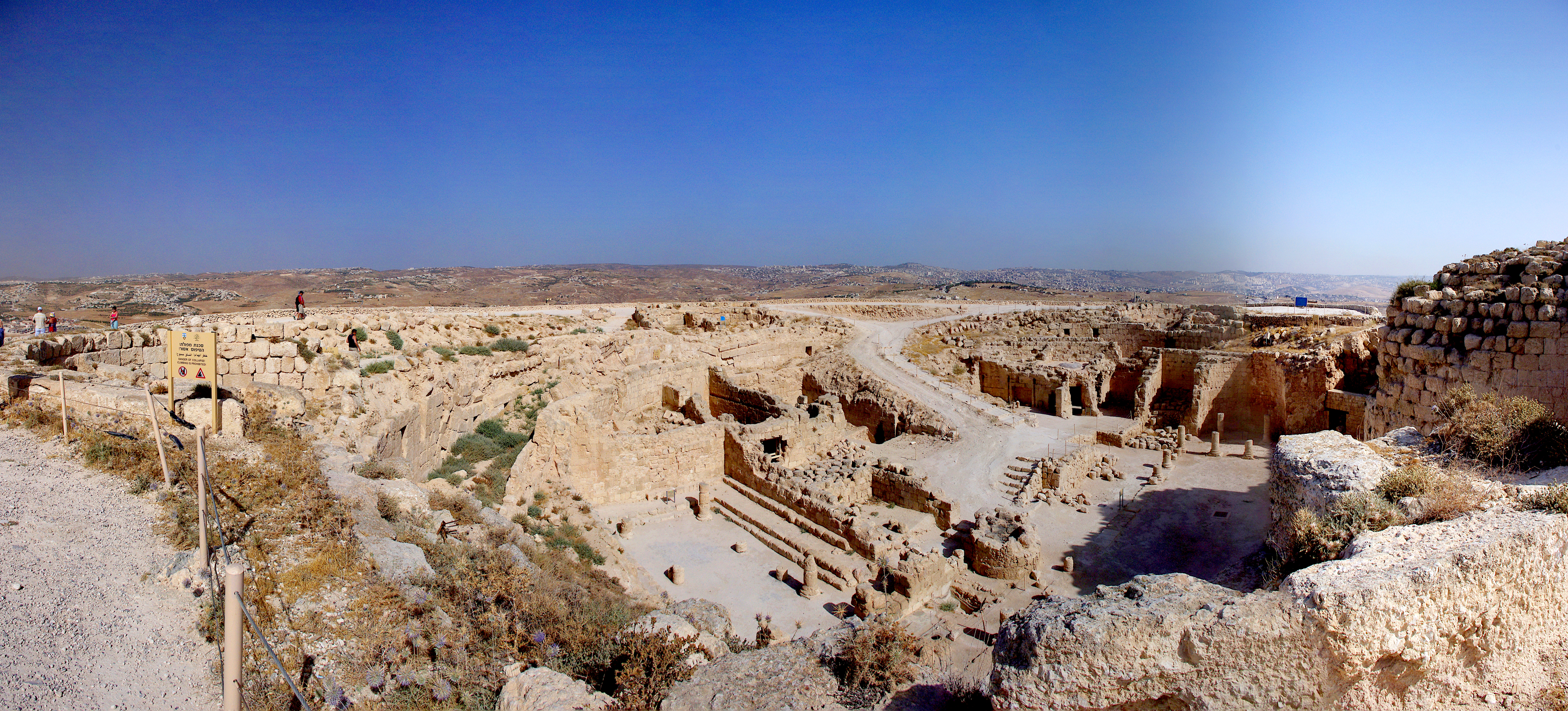
Herodium is an artificial, cone-shaped hill fortress-palace constructed by Herod the Great approximately 23–15 BC, situated roughly 12 kilometers south of Jerusalem in the Judean Desert near Bethlehem. The site comprises two distinct complexes: the Upper Herodium, an elaborately engineered hilltop palace enclosed within a cylindrical double wall featuring four towers, and the Lower Herodium, a sprawling estate including gardens, a monumental pool, and administrative structures. Herod reportedly selected the location to commemorate a military victory over Parthian-backed rivals in 40 BC, and ancient sources, particularly Josephus, identify it as his chosen burial site. Excavations led by Ehud Netzer between 1972 and 2010 uncovered a mausoleum on the northeastern slope of the upper hill, along with fragments of a decorated sarcophagus that Netzer and subsequent researchers have attributed to Herod himself, though this identification remains a subject of ongoing scholarly discussion rather than absolute consensus. The tomb's destruction, evidenced by deliberate smashing of the sarcophagus, may reflect hostility toward Herod's memory among later Jewish populations. Scripturally, Herodium is not named in the New Testament, but the Gospels of Matthew and Luke situate the narrative of Jesus's birth within the reign of Herod the Great (Matthew 2:1; Luke 1:5), and Matthew 2:16 describes Herod's order to kill infants in Bethlehem's vicinity—a region immediately proximate to Herodium. The site thus provides substantial material context for understanding Herodian power, architecture, and territorial administration during the period the Gospels describe, without itself confirming any specific Gospel episode. Sources: Israel Antiquities Authority excavation reports; Ehud Netzer, *The Architecture of Herod the Great Builder* (Mohr Siebeck, 2006); Israel Exploration Journal; Herodium National Park (Israel Nature and Parks Authority).
Herodium offers direct archaeological evidence of Herod the Great's monumental building programs and likely preserves his burial context, grounding the political and geographic world presupposed by the Matthean and Lukan infancy narratives in recoverable material history. Its ongoing excavation continues to refine scholarly understanding of Herodian-period Judea on the eve of the first century AD.