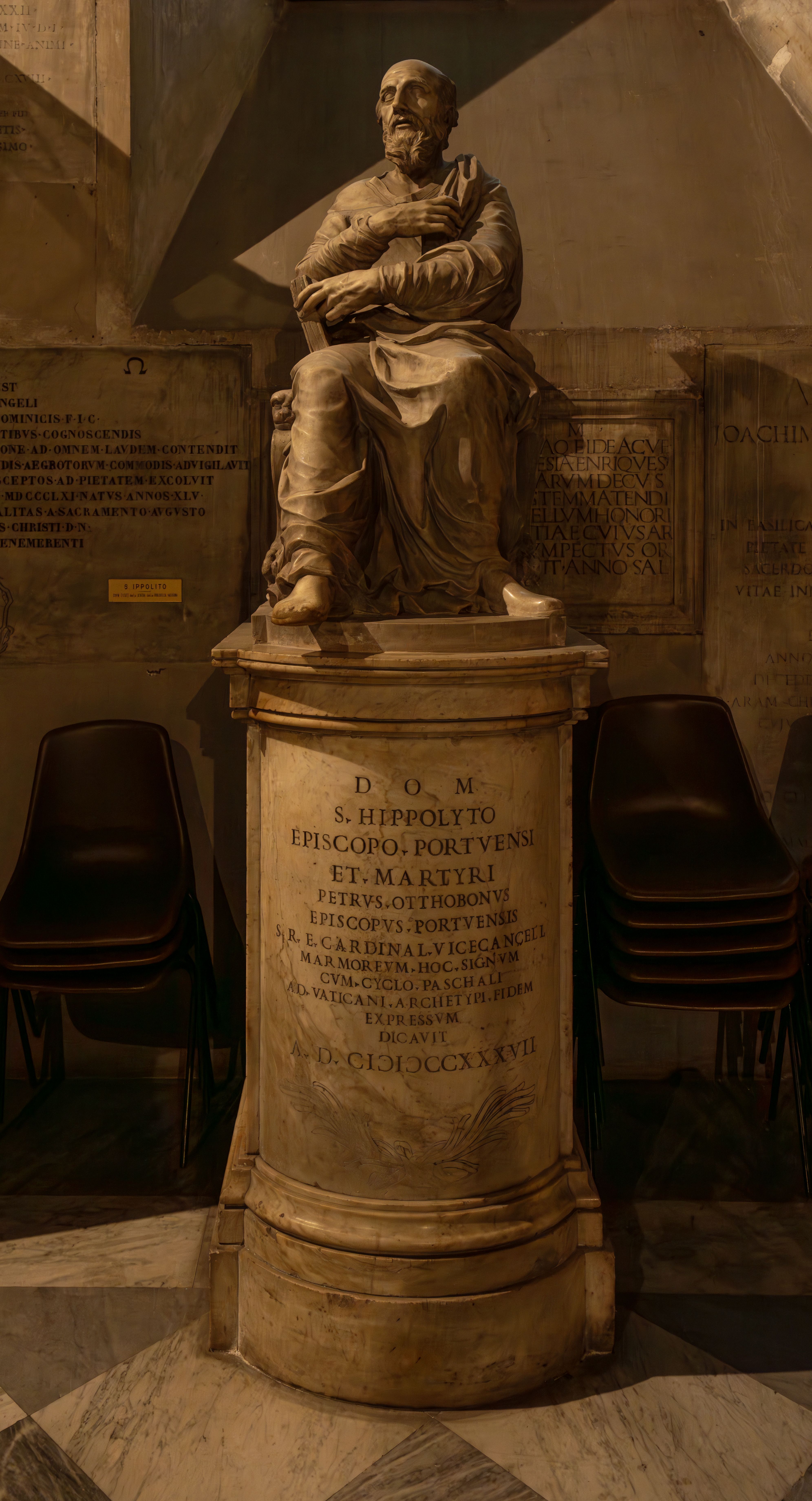
The text conventionally attributed to Hippolytus of Rome dates to approximately AD 215, though the attribution and precise composition history remain subjects of ongoing critical discussion among scholars including Paul Bradshaw, Maxwell Johnson, and L. Edward Phillips. The work survives not in a single Greek original but in a constellation of ancient translations: a Latin palimpsest discovered at Verona in the nineteenth century (Biblioteca Apostolica Vaticana, MS Verona LV [53]), alongside Coptic, Arabic, Ethiopic, and Sahidic versions. Gregory Dix's 1937 critical edition for the Henry Bradshaw Society and the revised 2002 reconstruction by Bradshaw, Johnson, and Phillips (Hermeneia series, Fortress Press) remain the standard scholarly reference points. The document is a church-order text, meaning it prescribes liturgical procedures, ministerial qualifications, and community disciplines rather than narrating historical events. It spans approximately forty-three sections covering episcopal ordination, the eucharistic anaphora, baptismal preparation and immersion rites, daily prayer, and regulations for various community roles. The eucharistic prayer preserved in chapters 4 and 21 represents one of the oldest extant examples of such a text in any language, while chapters 15–21 detail a multi-stage catechumenate preceding baptism by immersion. For biblical study, the Apostolic Tradition contextualizes passages in Acts 2:42, 1 Corinthians 11:23–26, and Romans 6:3–4 by documenting how early communities institutionalized the practices those texts describe or presuppose. The episcopal qualifications outlined in 1 Timothy 3:1–7 and Titus 1:5–9 find organizational flesh in the ordination rites of chapters 2–3. Scholars use the text to reconstruct the liturgical matrix within which New Testament documents circulated and were read aloud in assembly. **Sources:** Paul F. Bradshaw, Maxwell E. Johnson, and L. Edward Phillips, *The Apostolic Tradition: A Commentary* (Fortress Press, 2002); Gregory Dix, ed., *The Treatise on the Apostolic Tradition of St Hippolytus of Rome* (Henry Bradshaw Society, 1937); Alistair Stewart-Sykes, *Hippolytus: On the Apostolic Tradition* (St Vladimir's Seminary Press, 2001); 1 Corinthians 11:23–26; Romans 6:3–4.
The Apostolic Tradition provides the earliest detailed documentation of eucharistic prayer, baptismal catechesis, and episcopal ordination outside the New Testament itself, offering a direct textual bridge between apostolic practice and third-century Roman Christian assembly life.