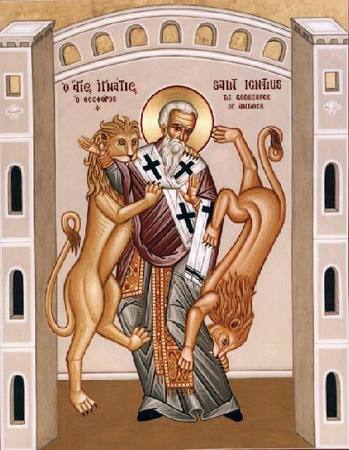
Ignatius of Antioch — third bishop of that city after Peter and Evodius, by the chain Eusebius preserves — was arrested under Trajan and sent overland and by sea to Rome to be killed by wild beasts in the amphitheater. The journey, which can be reconstructed from the letters themselves, ran from Antioch through Asia Minor with stops at Smyrna and Troas, then by ship through Macedonia. He arrived in Rome around AD 110 and was martyred there. Along the route, between roughly 107 and 110, he wrote seven letters: to the churches of Ephesus, Magnesia, Tralles, Rome, Philadelphia, Smyrna, and a personal letter to Polycarp. The letters are extraordinary for their immediacy. Ignatius writes as a condemned man who can hear the beasts approaching: "I am God's wheat, and I am being ground by the teeth of wild beasts that I may be found pure bread of Christ." He pleads with the Roman church not to intervene to save him. He insists on the threefold ministry — bishop, presbyters, deacons — with a force unmatched in the New Testament. He coins or canonizes the word "Catholic Church" (katholikē ekklēsia, "the whole church") as a designation in his Letter to the Smyrnaeans. The textual transmission is complicated. The letters survive in three Greek recensions: a long one with six additional letters now judged forgeries, a middle (shorter) one with the seven authentic letters, and a Syriac short recension with three. The seventeenth-century work of James Ussher and Isaac Voss established the middle recension as genuine — the consensus position since. Sources: J. B. Lightfoot, The Apostolic Fathers, Part II: S. Ignatius and S. Polycarp (1885); William R. Schoedel, Ignatius of Antioch (Hermeneia, 1985); Allen Brent, Ignatius of Antioch: A Martyr Bishop and the Origin of Episcopacy (2007); Bart Ehrman, ed., The Apostolic Fathers, vol. 1 (Loeb, 2003).
A martyr-bishop's pastoral correspondence written within a decade of John's death. Names the church's offices (bishop, presbyters, deacons), the Eucharist as "the flesh of our Savior Jesus Christ," and refers to the Gospels and Pauline letters as already-circulating scripture.