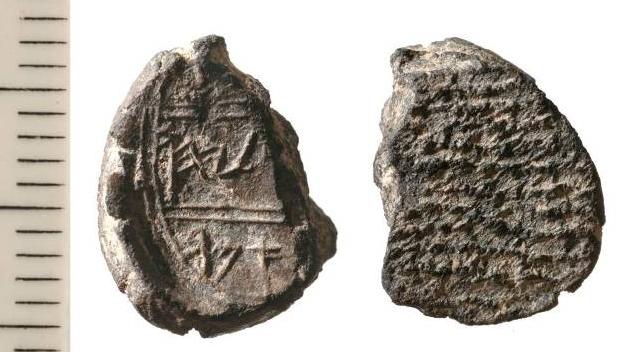
This clay bulla (seal impression) preserves a personal name ending in the theophoric element '-lyahu' (a form of the divine name Yahweh), followed by the patronymic 'son of Immer.' It was recovered through the Temple Mount Sifting Project, which systematically examines soil removed from the Temple Mount by the Waqf during 1999 construction work and deposited at Emek Tzurim National Park. The bulla is dated paleographically and contextually to the late Iron Age II period, roughly 700–586 BC, placing it squarely within the final century of the First Temple. Fashioned from fired clay, it retains partial legible Hebrew script in a script style consistent with late pre-exilic Judahite administrative practice. The patronymic 'Immer' is directly significant because the priestly family of Immer is attested in multiple biblical texts: Jeremiah 20:1 identifies Pashhur son of Immer as a chief officer of the Jerusalem Temple; Ezra 2:37 records 1,052 descendants of Immer among those returning from Babylonian exile; and 1 Chronicles 24:14 places the house of Immer in the sixteenth priestly division. The bulla does not identify its bearer with any specific individual named in these passages, but it materially corroborates that the Immer priestly family was active in Jerusalem's administrative or cultic sphere during the late monarchy. Scholarly caution is warranted regarding provenance, since the soil was not excavated in controlled stratigraphic conditions; nevertheless, the artifact's paleography and ceramic associations are considered consistent with a pre-586 BC date by the project's research team. Sources: Temple Mount Sifting Project (Barkay & Zweig, directors); Israel Exploration Journal; Eilat Mazar, 'The Temple Mount Excavations'; Israel Museum, Jerusalem.
The bulla provides rare epigraphic evidence for the Immer priestly family in late pre-exilic Jerusalem, lending material substance to the biblical portrait of that clan's prominence in Temple administration during the final decades of the First Temple period.