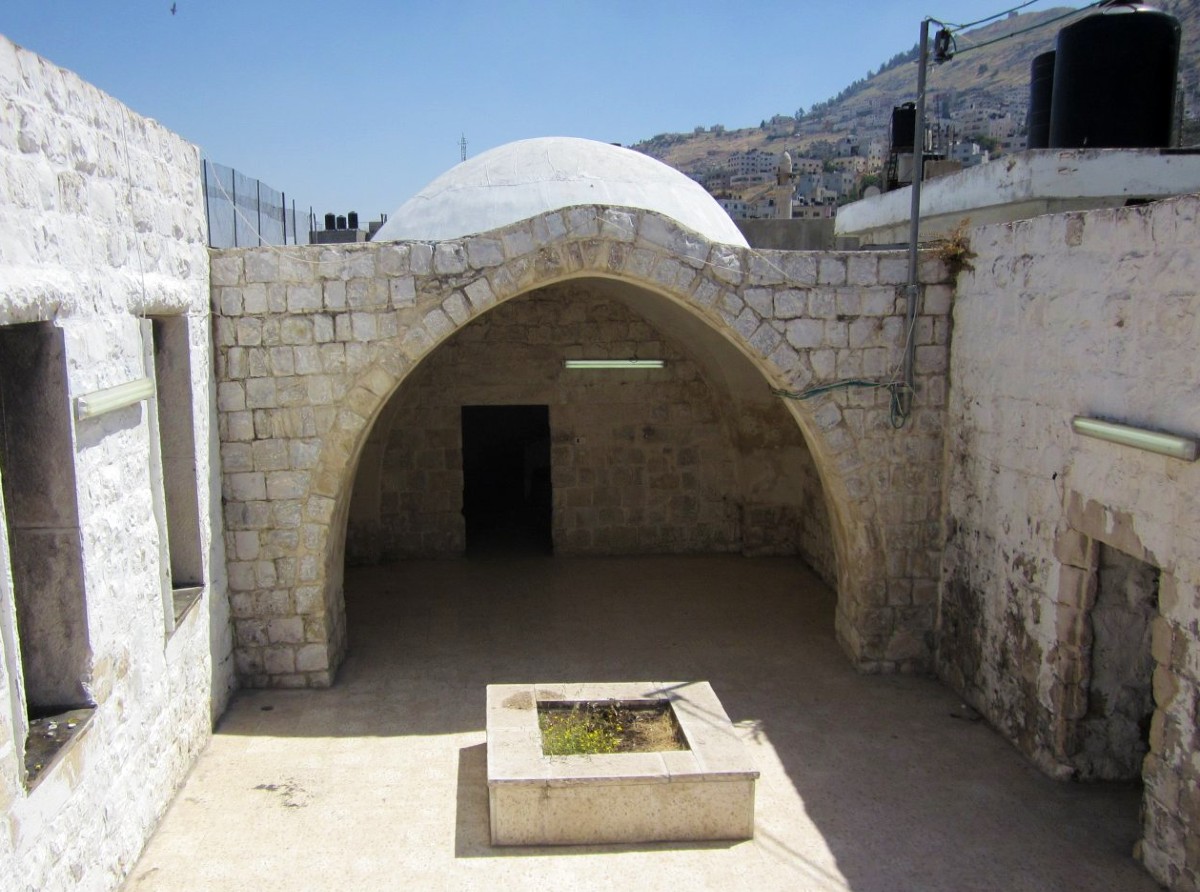
Joseph's Tomb stands at the eastern outskirts of Nablus, the modern city occupying the site of ancient Shechem in the central highlands of the West Bank. The structure is a small white-domed building enclosing a stone cenotaph, set in a walled courtyard at the foot of Mount Gerizim. Joshua 24:32 records the burial: "the bones of Joseph, which the children of Israel brought up out of Egypt, were buried at Shechem in the parcel of ground which Jacob bought from the sons of Hamor the father of Shechem for a hundred pieces of silver, and it became an inheritance of the descendants of Joseph." The reference connects to Genesis 33:19 (Jacob's purchase) and Genesis 50:25–26 (Joseph's deathbed instructions in Egypt), framing a four-century continuity from purchase to burial. The structure visible today is medieval in its present fabric, of twelfth- and thirteenth-century date, possibly built on older foundations whose chronology has not been securely established. As with Rachel's Tomb, the tradition of the location is ancient — the Bordeaux Pilgrim notes the burial of Joseph at Shechem in AD 333, and Eusebius mentions it in the Onomasticon — but the precise position carries the same complications: William G. Dever and Itzhaki Magen have noted that some Samaritan tradition places the tomb elsewhere on Mount Gerizim, and the medieval rebuilding obscured whatever Byzantine or earlier fabric may have stood beneath. The cenotaph itself is a medieval pilgrim object rather than a securely dated patriarchal burial. The site has been damaged repeatedly in modern conflict — burned during the Second Intifada in October 2000, attacked again in 2002, and damaged in further incidents in 2015. Israeli authorities and Jewish religious groups have rebuilt the structure each time. The site remains under coordinated Israeli-Palestinian security arrangement with restricted-hours Jewish pilgrimage access, alongside continuing recognition by local Muslim and Samaritan communities of the older shared tradition. Sources: William G. Dever, Beyond the Texts: An Archaeological Portrait of Ancient Israel and Judah (SBL Press, 2017); Itzhaki Magen, The Samaritans and the Good Samaritan (Israel Antiquities Authority, 2008); Eusebius, Onomasticon (c. AD 320), ed. Notley and Safrai; Bordeaux Pilgrim (AD 333); Joshua 24:32.
The site anchors a textual chain spanning Genesis 33:19, Genesis 50:25–26, and Joshua 24:32, making it the only location where a patriarchal burial narrative receives explicit geographic confirmation in the Hebrew Bible. Its medieval fabric and contested Samaritan alternative tradition complicate any direct archaeological correlation with the biblical account.