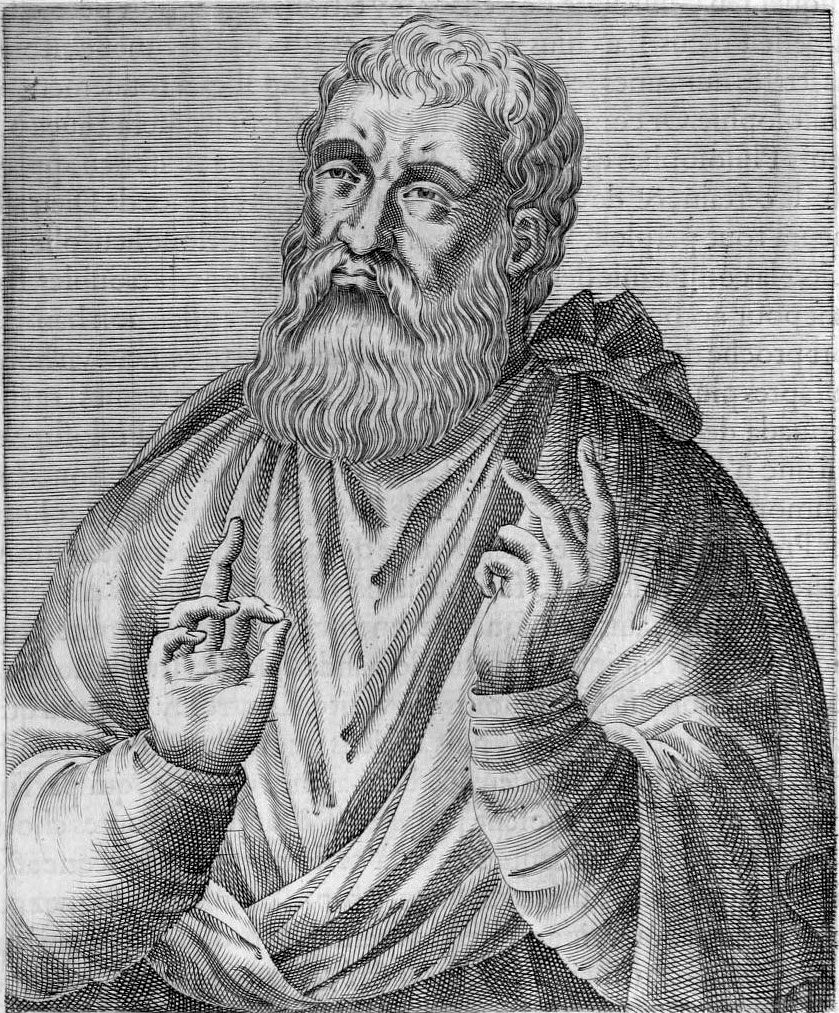
Justin Martyr was born around AD 100 to a Greek family in Flavia Neapolis (modern Nablus) on Mount Gerizim in Samaria. He pursued the Stoic, Peripatetic, Pythagorean, and Platonist schools in turn — the autobiographical opening of his Dialogue with Trypho narrates the journey — before, on a beach near Ephesus, an old man pointed him to the Hebrew prophets. He converted, kept the philosopher's cloak, and opened a school of Christian instruction in Rome in the 140s. The First Apology, addressed to the emperor Antoninus Pius, his sons Marcus Aurelius and Lucius Verus, and the Roman Senate, was composed there around AD 155. The text defends Christianity against three pagan slanders — atheism, cannibalism, and incest — and argues that Christians are the empire's most loyal subjects. Justin describes a typical Sunday liturgy at length: scripture reading from "the memoirs of the apostles or the writings of the prophets, as long as time permits"; a homily by the presider; common prayer; the Eucharist; and a collection for widows, orphans, the sick, and travelers. The "memoirs of the apostles" Justin equates with the Gospels — the earliest external attestation of the four-Gospel tradition functioning as scripture in Christian worship. Justin was denounced by the Cynic philosopher Crescens, arrested under the urban prefect Junius Rusticus around AD 165, and beheaded with six companions. The court record — the Acta Justini — survives in three recensions and is among the most authentic pre-Decian martyr-acts. His apologies and the Dialogue are the chief surviving works of second-century philosophical Christianity. Sources: Acta Justini (ed. Musurillo, Acts of the Christian Martyrs, 1972); Leslie W. Barnard, Justin Martyr: His Life and Thought (1967); Sara Parvis and Paul Foster, eds., Justin Martyr and His Worlds (2007); Eric F. Osborn, Justin Martyr (1973).
The earliest surviving description of a Sunday Christian service, written within ~120 years of Pentecost. Confirms the order of worship, the use of the Gospels in the liturgy, and the centrality of the Eucharist long before Constantine.