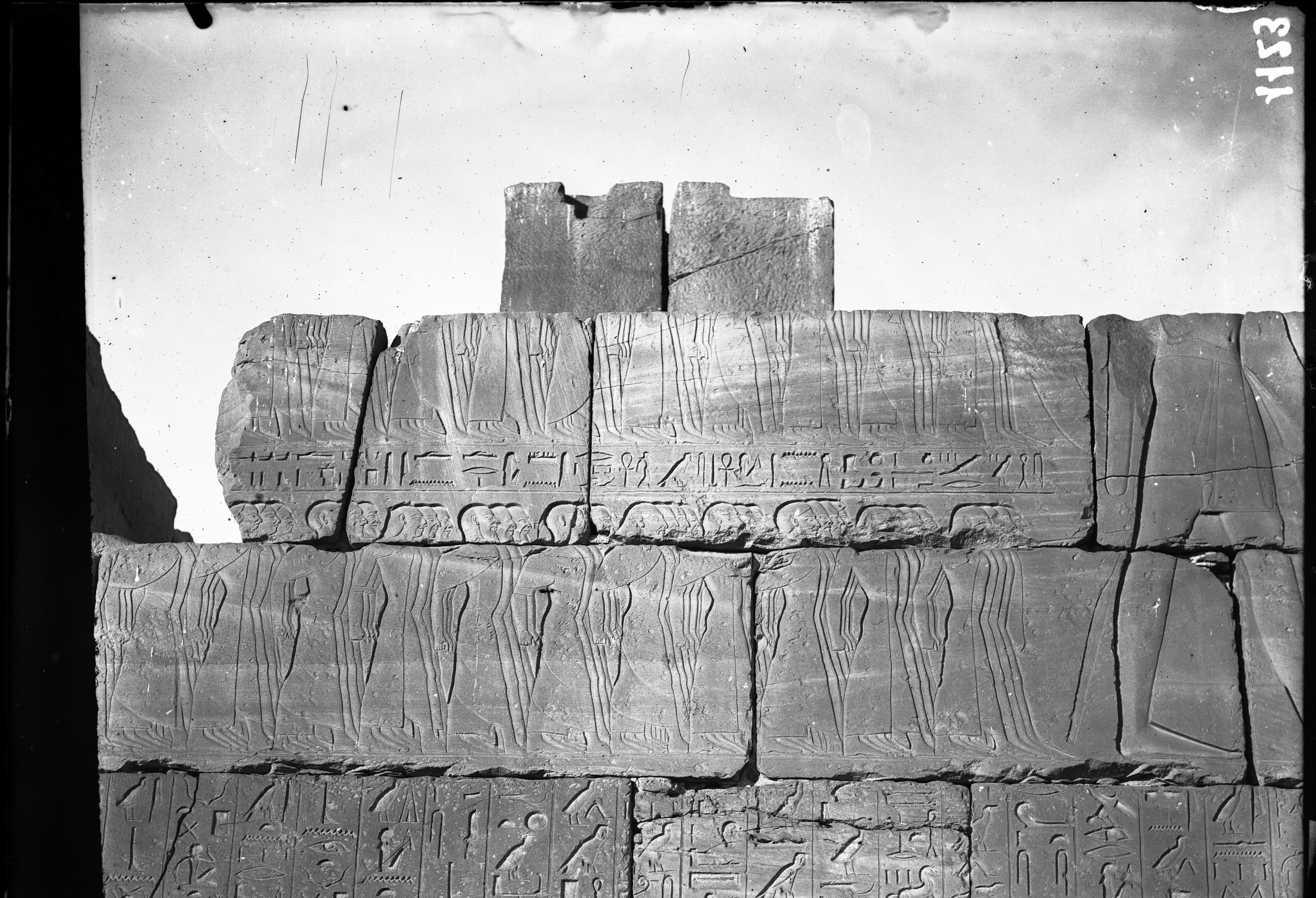
The battle reliefs commemorating Ramesses II's campaign against the Hittite coalition at Kadesh (c. 1274 BC) were carved across multiple Egyptian temple complexes, with the Karnak sequence representing one of the primary monumental expressions. Executed during Ramesses II's reign (c. 1279–1213 BC), these reliefs are among the most extensively studied examples of New Kingdom commemorative art. They remain largely in situ at the Hypostyle Hall and outer walls of the Karnak temple complex in Luxor, with parallel versions at the Ramesseum and Abu Simbel. Epigraphic documentation was significantly advanced by the work of orientalist scholars including James Henry Breasted in the early twentieth century and subsequently by the Oriental Institute's Epigraphic Survey. The reliefs span extensive wall surfaces and depict in carved and originally painted detail the Egyptian army's formation, the chariot charge, the encamped military layout, and the siege of Kadesh on the Orontes River in modern Syria. Hieroglyphic inscriptions accompanying the images incorporate portions of the so-called Poem of Pentaur, one of the earliest known extended literary narratives of a military engagement. The reliefs document the Egyptian two-wheeled chariot corps, infantry divisions named after major deities, and the logistical structure of a Late Bronze Age imperial campaign. These same military technologies—massed chariotry and large infantry contingents—are referenced in biblical texts describing Egyptian and Canaanite forces opposing Israelite groups (Exodus 14:6–7; Joshua 11:4). For biblical study, the Kadesh reliefs illuminate the material and organizational backdrop against which the Exodus and Conquest traditions were shaped. They confirm Egyptian dominance over Canaan during the Nineteenth Dynasty period, corroborating biblical references to Egyptian control of strategic cities. The reliefs also demonstrate the scale of chariot-based military power that biblical texts associate with Egyptian and Canaanite opposition to Israelite settlement in Canaan, grounding those narratives in a recoverable historical and military context. **Sources:** James Henry Breasted, *Ancient Records of Egypt*, vol. 3 (University of Chicago Press, 1906); Kenneth Kitchen, *Pharaoh Triumphant: The Life and Times of Ramesses II* (Aris & Phillips, 1982); Donald Redford, *Egypt, Canaan, and Israel in Ancient Times* (Princeton University Press, 1992); Exodus 14:6–7; Joshua 11:4.
The Kadesh reliefs constitute the most detailed surviving record of Late Bronze Age Egyptian military organization and chariot warfare, providing material context for biblical descriptions of Canaanite and Egyptian military power encountered during the Exodus and conquest narratives.