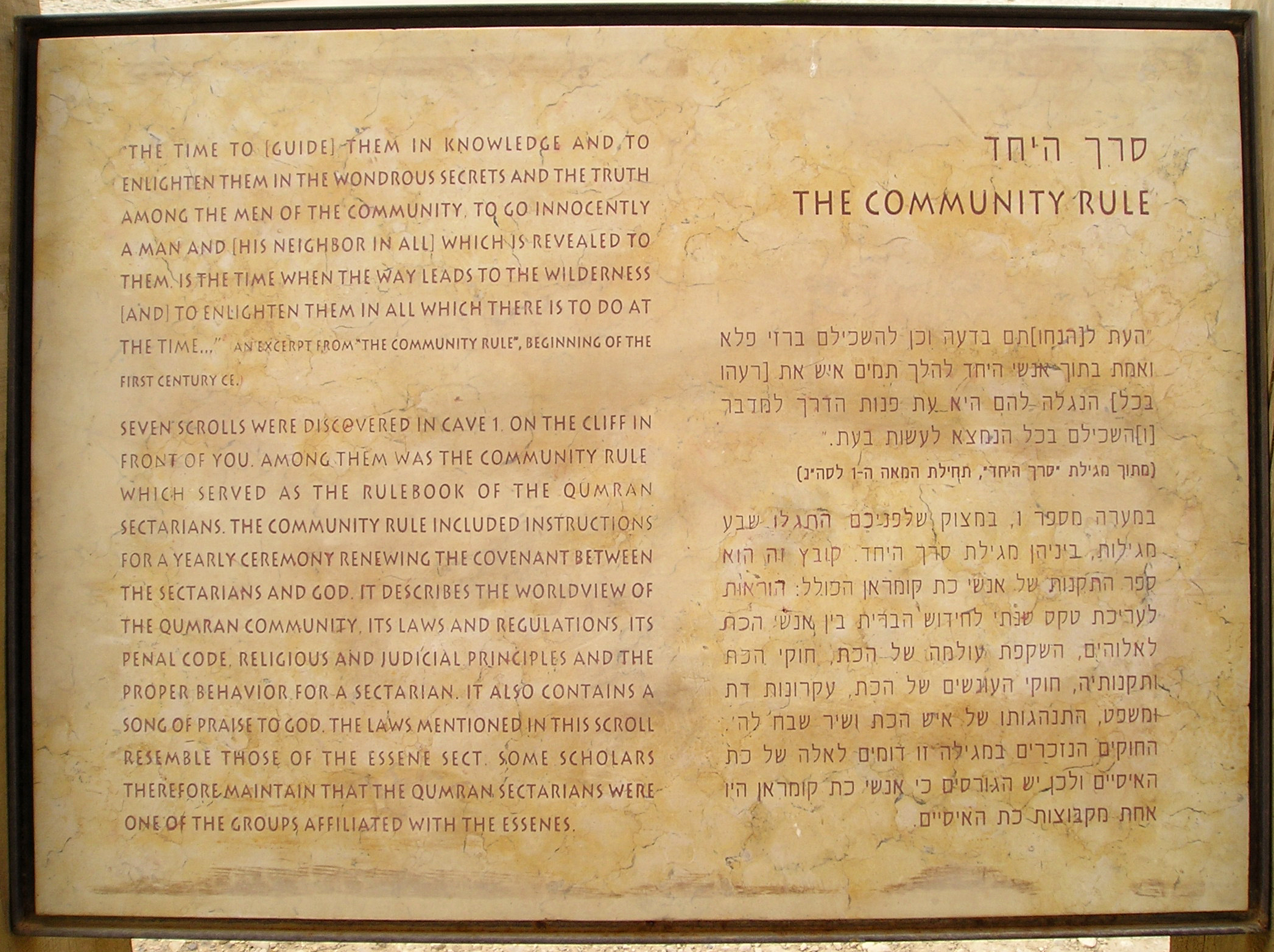
Khirbet Qumran occupies a marl terrace approximately 1.5 kilometers west of the Dead Sea's northwest shore in the Judean Desert. Systematic excavation was conducted between 1951 and 1956 under Roland de Vaux of the École Biblique et Archéologique Française, Jerusalem, following the initial discovery of scroll jars in nearby Cave 1 by Bedouin shepherds in 1947. Subsequent seasons were directed by de Vaux with Józef Tadeusz Milik and Frank Moore Cross as philological collaborators. Later reinvestigation was undertaken by Yizhar Hirschfeld (1996–2002) and by the Hebrew University–led team under Magen Broshi and Hanan Eshel, and by Randall Price and Oren Gutfeld in more recent cave surveys. The built complex covers roughly 80 by 100 meters and includes a scriptorium identified by de Vaux on the basis of two plaster writing benches and inkwells recovered from Locus 30, multiple cisterns fed by an aqueduct from Wadi Qumran, a refectory, assembly hall, and pottery kilns. Numismatic evidence and stratigraphy indicate continuous occupation from approximately 100 BC through the First Jewish Revolt, when the site was destroyed circa AD 68, corresponding to the period of Vespasian's Judean campaign. The associated caves yielded roughly 900 manuscripts in Hebrew, Aramaic, and Greek, including the oldest surviving copies of nearly every book of the Hebrew Bible—most notably a complete Isaiah scroll (1QIsa-a) directly paralleling the Masoretic text of Isaiah 40:3, the wilderness-preparation passage cited in all four Gospels. Khirbet Qumran situates the Dead Sea Scrolls within an identifiable community widely associated with a separatist Jewish movement, likely Essene in character according to the consensus reading of ancient sources including Pliny the Elder and Josephus. The site's scriptorium and communal architecture illuminate the disciplined textual-copying environment that preserved pre-Masoretic biblical manuscripts, offering crucial data on the plurality of textual traditions circulating in Second Temple Judaism. The settlement remains under the administrative jurisdiction of the Israel Nature and Parks Authority, with excavated objects catalogued by the Israel Antiquities Authority under IAA accession series from the 1950s campaigns. **Sources:** Roland de Vaux, *Archaeology and the Dead Sea Scrolls* (Oxford University Press, 1973); Frank Moore Cross, *The Ancient Library of Qumran*, 3rd ed. (Fortress Press, 1995); Emanuel Tov, *Textual Criticism of the Hebrew Bible*, 3rd ed. (Fortress Press, 2012); Isaiah 40:3; Habakkuk 1:1–2:20.
Khirbet Qumran provides the physical and social context for the Dead Sea Scrolls, anchoring the manuscript tradition to a datable Jewish community whose scriptural copying practices illuminate textual transmission and Second Temple biblical interpretation.