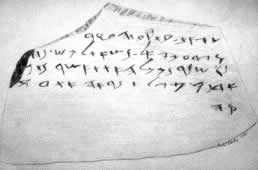
The Lachish Letters were unearthed in 1935 by the British archaeologist James Leslie Starkey at the gate-guardroom of Tell ed-Duweir, identified with biblical Lachish — the chief Judean fortress on the Shephelah southwest of Jerusalem. Twenty-one inscribed pottery shards (ostraca), written in carbonized ink in paleo-Hebrew, were recovered from a destruction layer dated by the excavator to the Babylonian campaign of 588-586 BC. The letters constitute the only substantial corpus of Hebrew correspondence surviving from the kingdom of Judah's final months before the fall of Jerusalem. Most of the ostraca are letters from a junior officer named Hoshaiah, posted at an outlying station, to Yaush, the commander of Lachish. They report movements of troops, deserters, the morale of frightened scribes, and — most famously — fire-signal communications between fortified cities. Letter 4 records: "we are watching for the signal-fires of Lachish according to all the signs my lord has given, because we cannot see Azekah." Jeremiah 34:7 names exactly these two cities — Lachish and Azekah — as the last Judean fortresses still resisting Nebuchadnezzar. The ostracon almost certainly preserves the moment Azekah's signal had ceased and Lachish was alone. The Babylonian destruction layer matches the dramatic historical setting precisely: the gate complex was burned, the rooms collapsed, the ostraca lay where they fell. Starkey was murdered by bandits in 1938 before completing publication; Olga Tufnell brought out the final report in 1953. The corpus is in the British Museum and the Israel Museum. Sources: Harry Torczyner, The Lachish Letters (Lachish I, 1938); Olga Tufnell, Lachish III: The Iron Age (1953); David Ussishkin, The Conquest of Lachish by Sennacherib (1982); Frank Moore Cross, "Epigraphic Notes on Hebrew Documents of the 8th-6th Centuries BC," BASOR 165 (1962).
Matches Jeremiah 34:7 verbatim: only Lachish and Azekah remained of Judah's fortified cities. The ostraca are the last surviving Hebrew documents from the kingdom of Judah before the exile.