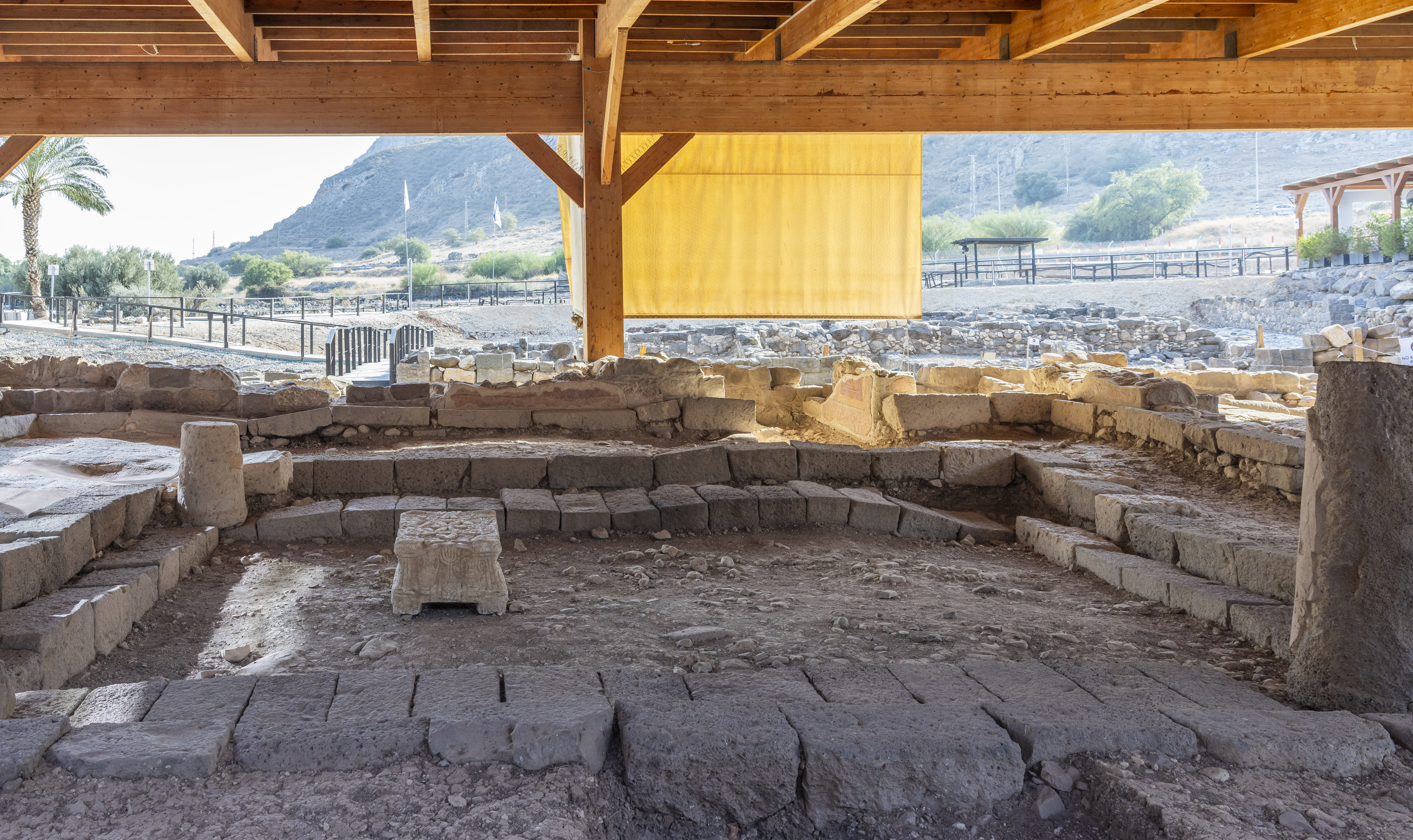
Magdala — known in the Talmud as Migdal Nunaya ("Tower of the Fish") and in Greek sources as Tarichaea — sat on the western shore of the Sea of Galilee, three miles north of Tiberias. The town was Mary Magdalene's home (Luke 8:2). Excavations from 2009 onward, conducted jointly by the Israel Antiquities Authority and the Anáhuac University of Mexico, exposed a remarkably preserved 1st-century town: a market street, ritual baths fed by underground springs, a fish-processing complex, and at the center a synagogue with stone benches and frescoed walls. At the synagogue's center, set on the floor between the benches, lay a unique carved limestone block, roughly two feet square. The Magdala Stone is decorated on five sides with motifs whose specificity has no parallel anywhere in surviving Jewish art before the destruction of the Temple in AD 70. The front face shows a seven-branched menorah flanked by two amphorae, beneath an arch and between two columns — the menorah of the Second Temple as it stood in the inner sanctuary. The other faces show architectural elements, rosettes, and what may be the chariot of God (the merkavah) referenced in Ezekiel 1. The most striking interpretation, advanced by the excavator Dina Avshalom-Gorni and supported by Steven Fine and Mordechai Aviam, is that the stone was carved by an artisan who had personally entered the Holy Place of the Jerusalem Temple — possibly a priest who served his rotation at Jerusalem and returned home. The synagogue was abandoned at the time of the First Jewish Revolt; the stone was found in situ. A replica is at the site; the original is at the Israel Museum. Sources: Mordechai Aviam, "The Decorated Stone from the Synagogue at Migdal," Novum Testamentum 55 (2013); Steven Fine, The Menorah: From the Bible to Modern Israel (2016); Dina Avshalom-Gorni and Arfan Najar, "Migdal Excavation Reports," IAA Hadashot Arkheologiyot (2009-); Rina Talgam, Mosaics of Faith (2014).
A 1st-century synagogue with art only an eyewitness to Herod's Temple could have made, in the town where Mary Magdalene lived. Jesus likely taught in this very building during his Galilean ministry.