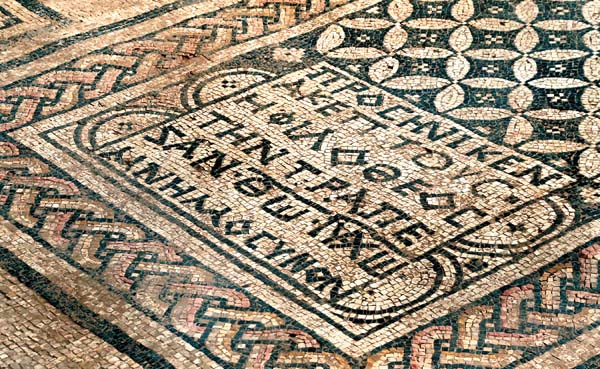
In 2005, prison inmates of Megiddo Prison — built atop the ancient mound of Megiddo in the Jezreel Valley — were digging foundations for a new wing when their tools struck an in situ mosaic floor. Yotam Tepper, the IAA archaeologist who took over excavation, exposed a 580-square-foot floor belonging to a 3rd-century building that he and his colleagues identified as a Christian house-church or prayer hall — among the earliest known anywhere. The mosaic features a central panel of fish (an early Christian Eucharistic symbol), geometric motifs, and three Greek inscriptions. The most important inscription, set in a tabula ansata, reads: "The God-loving Akeptous has offered the table to God Jesus Christ as a memorial." A second inscription names four women — Primilla, Cyriaca, Dorothea, and Chreste — and asks remembrance for them; a third names a Roman centurion, Gaianus, who funded the floor "from his own resources." The lettering and paleography are firmly 3rd-century, predating the Constantinian peace by roughly fifty years. The find matters most for what it shows about pre-Constantinian Christianity in Palestine. The "table" Akeptous donated is almost certainly a stone communion table; the Greek phrase "to God Jesus Christ" identifies Jesus theologically as God in language anticipating the Nicene formulation. Centurion patronage of a Christian community in a Roman military zone, before legalization, complicates older narratives of underground catacomb-only worship. The mosaic was lifted, conserved, and is currently in storage; plans to return it to a public site at Megiddo have been delayed by the prison's status. The inmate population was relocated; the prison itself is being repurposed. Sources: Yotam Tepper and Leah Di Segni, A Christian Prayer Hall of the Third Century AD at Kefar 'Othnay (Legio) (IAA, 2006); William Tabbernee, Early Christianity in Contexts (2014); Vassilios Tzaferis, "Inscribed 'To God Jesus Christ,'" BAR 33:2 (2007); Israel Antiquities Authority Megiddo Prison excavation reports (2005-).
Settles a long-running skeptical claim that Jesus's deity was a 4th-century Constantinian invention. By 230 AD, ordinary Christians like Akeptous were paying for mosaic inscriptions calling Jesus God on a memorial table.