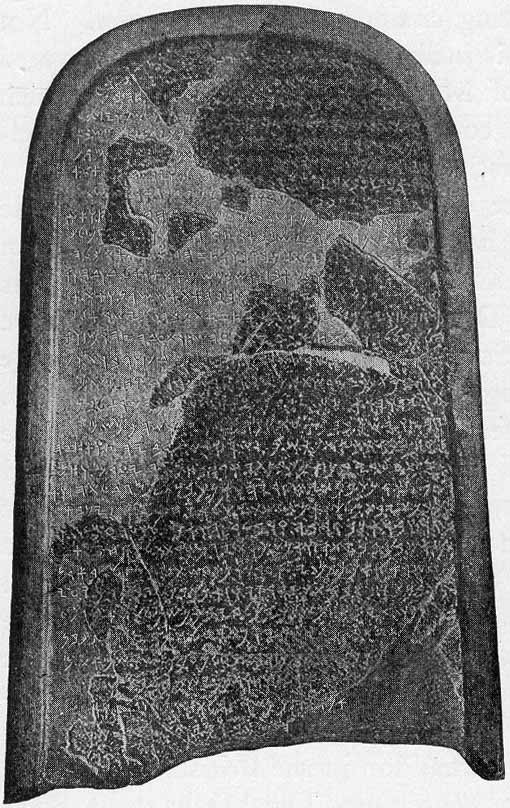
The Mesha Stele — also known as the Moabite Stone — is a 3-foot, 200-pound block of black basalt discovered in 1868 at Dibon (modern Dhiban) in Jordan by the Alsatian missionary Frederick Augustus Klein. Local Bedouin, recognizing the stone's value, broke it into pieces in a quarrel with the Ottoman authorities; Charles Clermont-Ganneau, working through intermediaries, secured paper squeezes before destruction and recovered most of the fragments. The reconstructed stele, now in the Louvre, preserves thirty-four lines erected by King Mesha of Moab around 840 BC. The inscription, written in a Moabite dialect very close to biblical Hebrew, recounts Mesha's rebellion against the kingdom of Israel — the same revolt described from the Israelite side in 2 Kings 3. Mesha names "Omri king of Israel" who oppressed Moab "many days, for Chemosh was angry with his land," and credits his god Chemosh with the deliverance. The divine name Yahweh appears in line 18: Mesha boasts of dragging "the vessels of Yahweh" before Chemosh. The text also describes the herem, the ban-slaughter that the Hebrew Bible attributes to early Israelite warfare. In line 31, André Lemaire's 1994 reading proposed bytdwd — "House of David" — paralleling the Tel Dan inscription discovered the year before. The reading is contested: Anson Rainey accepted it; Pierre Bordreuil read it as bytdwh, "house of his uncle." A 2019 reanalysis using Reflectance Transformation Imaging concluded the line cannot be confidently recovered. The fundamental witness to a 9th-century Moab in conflict with the Omride dynasty is secure regardless. Sources: André Lemaire, "'House of David' Restored in Moabite Inscription," BAR 20:3 (1994); Kent P. Jackson, "The Language of the Mesha Inscription," in Andrew Dearman, ed., Studies in the Mesha Inscription and Moab (1989); Israel Finkelstein, Nadav Na'aman, and Thomas Römer, "Restoring Line 31 in the Mesha Stele," Tel Aviv 46 (2019); P. Kyle McCarter Jr., Ancient Inscriptions: Voices from the Biblical World (1996).
Independent royal confirmation of the events 2 Kings 3 narrates from Israel's side — Mesha's rebellion against Joram. Names Omri, the dynasty Ahab belonged to, and refers to YHWH by name, anchoring Israelite worship in the same century the Bible places it.