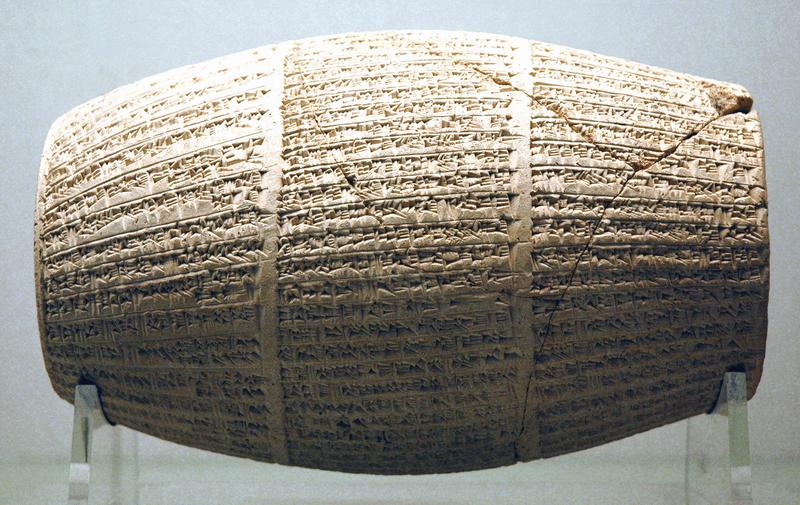
The Nabonidus Cylinder from Sippar was excavated in the nineteenth century at the ancient site of Sippar (modern Abu Habbah, Iraq), a city on the Euphrates northwest of Babylon. The artifact entered the collections of the British Museum, London, where it is catalogued as BM 91125. It is one of several cuneiform cylinders and prisms associated with Nabonidus (reigned c. 556–539 BC), the last indigenous ruler of the Neo-Babylonian Empire, and was identified and studied by Assyriologists including Theophilus Pinches in the late nineteenth century and subsequently subjected to fuller philological analysis by scholars such as Paul-Alain Beaulieu in the twentieth century. The artifact is a baked clay four-sided prism, inscribed in Neo-Babylonian cuneiform script. The text records dedicatory and votive activities undertaken by Nabonidus, including the restoration of temples and the entrusting of royal authority in Babylon to his eldest son Bel-šarra-uṣur — the biblical Belshazzar — while Nabonidus himself undertook an extended residence at Tayma in northwestern Arabia. The inscription explicitly names Belshazzar and describes him as occupying the position of effective governing authority in Babylon during his father's prolonged absence, a detail corroborated by administrative and economic tablets from the same period. For biblical scholarship, the Sippar Cylinder is of considerable significance in relation to Daniel 5, where Belshazzar presides over Babylon on the night of its fall to the Medes and Persians and is described as king. Earlier critical scholarship questioned this designation, since classical sources named Nabonidus as the last Babylonian king. The cylinder, alongside related administrative texts, clarifies that Belshazzar exercised de facto royal functions as co-regent, explaining both the historical reality and the biblical characterization. The text also illuminates the broader Neo-Babylonian context assumed throughout the book of Daniel and informs readings of prophetic literature addressing Babylon's decline in Isaiah and Jeremiah. **Sources:** Paul-Alain Beaulieu, *The Reign of Nabonidus, King of Babylon 556–539 BC* (Yale University Press, 1989); A. K. Grayson, *Assyrian and Babylonian Chronicles* (Augustin, 1975); Tremper Longman III, *Daniel*, NIV Application Commentary (Zondervan, 1999); Daniel 5:1-31; Isaiah 47:1-15.
The Sippar Cylinder of Nabonidus independently attests Belshazzar's role as crown prince and co-regent, directly resolving a long-standing critical objection to the historicity of Daniel 5, where Belshazzar is designated king of Babylon.