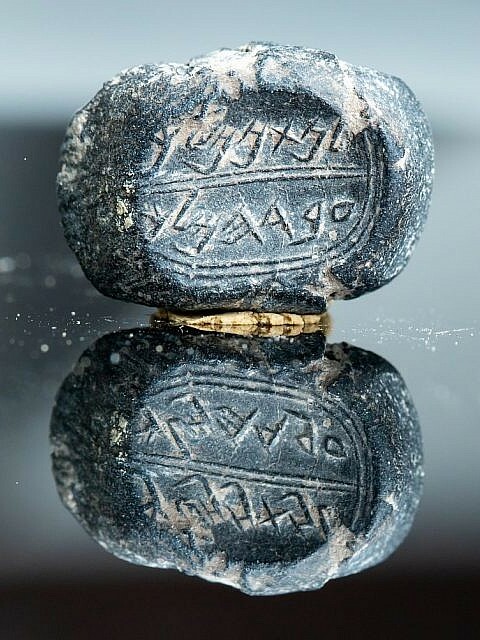
This clay bulla — a small, fired seal impression — bearing the inscription 'Belonging to Nathan-Melech, Servant of the King' (לנתן-מלך עבד המלך) was recovered from the Givati Parking Lot excavations in the City of David, Jerusalem, conducted under the auspices of the Israel Antiquities Authority. The impression dates to the late 7th or early 6th century BC, placing it squarely within the final decades of the Judahite monarchy. It was found in a destruction layer consistent with the Babylonian campaigns against Jerusalem, which lends credibility to its stratigraphic date. The bulla is paleo-Hebrew in script, oval in form, and preserves two registers of text separated by a double line — a format typical of administrative seals from this period. The title 'Servant of the King' (עבד המלך) denotes a high-ranking royal official, not a menial functionary. A figure named Nathan-Melech appears in 2 Kings 23:11, identified as an official ('saris') in whose chamber horses dedicated to the sun were stabled at the Temple entrance — an idolatrous practice abolished during Josiah's reform. While the name and title on the bulla are consistent with this biblical figure, and the date range aligns with Josiah's reign (640–609 BC), scholars appropriately caution that Nathan-Melech was not an uncommon compound name in ancient Judah, and a direct identification cannot be made with certainty. The artifact nonetheless materially attests the existence of officials bearing this precise name and title in Jerusalem during the relevant period. Sources: Israel Antiquities Authority (holding institution); Anat Mendel-Geberovich and Joe Uziel, Israel Exploration Journal 69/2 (2019); Israel Exploration Society publication records.
The bulla provides epigraphic confirmation that a royal official named Nathan-Melech operated in Jerusalem during the late monarchic period, offering a rare point of material contact with a named figure in the Josianic narrative of 2 Kings 23, though a one-to-one identification remains tentative rather than proven.