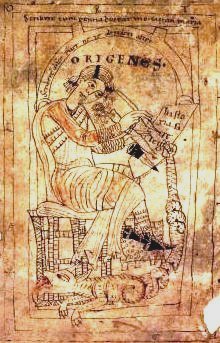
Origen of Alexandria (c. 185-254) was the most prolific scholar of the early church and arguably its first true textual critic. After fleeing the persecution of Septimius Severus that took his father in 202, he succeeded Clement as head of the catechetical school at Alexandria, then moved to Caesarea in Palestine around 232 after a dispute with Bishop Demetrius. The Hexapla — Greek for "sixfold" — was the great labor of his Caesarea years and the last decades of his life. It was a six-column synopsis of the Old Testament, set side by side: the Hebrew text in Hebrew letters, a Greek transliteration of the Hebrew (the Secunda), Aquila's rigid Greek translation, Symmachus's polished one, the Septuagint with critical sigla, and Theodotion's revision. The work served a polemical and a textual purpose: Origen wanted to settle disputes with rabbinic interlocutors over which Hebrew readings were authentic, and to establish a critical Septuagint text by marking with the obelus passages present in the Greek but absent in the Hebrew, and with the asterisk passages absent from the Greek but supplied from the other Greek versions. The full Hexapla ran to perhaps fifty parchment volumes — six thousand pages by Eusebius's reckoning — and was housed at the library of Caesarea founded by Pamphilus. The library was destroyed in the 7th-century Arab conquest, and the Hexapla disappeared with it. Substantial fragments survive — the Cairo Genizah Hexapla palimpsest, the Mercati palimpsest, scattered marginal readings in later Greek and Syriac manuscripts — and Frederick Field's monumental 1875 collection remains the standard reference. Modern editions continue: the Hexapla Institute project is currently producing volume-by-volume reconstructions. Sources: Frederick Field, Origenis Hexaplorum quae supersunt (1875); Eusebius, Ecclesiastical History 6.16; Anthony Grafton and Megan Hale Williams, Christianity and the Transformation of the Book (2006); Peter J. Gentry, "The Aristarchian Signs in the Textual Tradition of LXX Ecclesiastes," in The Hexapla and Fragments (Hexapla Institute, ongoing).
The first systematic textual criticism of the Old Testament. Origen's work shaped how Christians thought about Scripture for centuries and produced the textual variants quoted by later fathers like Jerome.