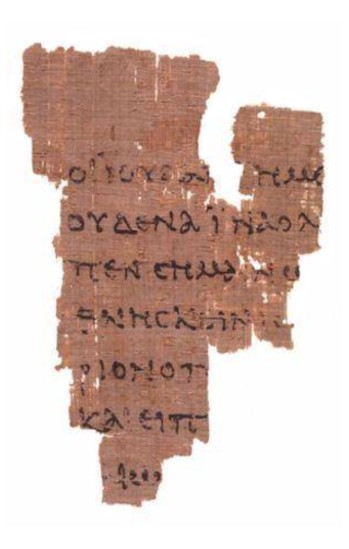
P52 — formally Papyrus Rylands Greek 457, housed at the John Rylands Library in Manchester — is a credit-card-sized fragment of a papyrus codex acquired by Bernard Grenfell in Egypt in 1920 along with a batch of other papyri and not identified until C. H. Roberts published the editio princeps in 1935. The fragment measures roughly 3.5 by 2.5 inches and preserves portions of eight lines of John 18:31-33 on the recto and 18:37-38 on the verso — Jesus before Pilate, the dialogue about kingship and truth. The fragment is the oldest known piece of any New Testament manuscript. Roberts dated the script paleographically to the first half of the 2nd century, "before AD 150," with a likely date around 125. More recent paleographic analysis — Brent Nongbri's 2005 study most prominently — has argued that the script could plausibly fall anywhere within a wider window from the late 1st through the late 2nd century, on the principle that paleographic dating cannot be fixed more narrowly than about fifty years. Roberts's narrower date is still common in textbooks; the broader window is the more rigorous reading. Even on the broader dating, P52 is decisive evidence that John's Gospel was circulating in codex form in Egypt within at most a few generations of its composition — almost certainly within the lifetime of people who had known the Gospel's author. The text agrees substantively with later witnesses: there are no significant variant readings on the surviving lines. The find moved the question of the date of the Fourth Gospel from the late 2nd century — where some critics had wanted to push it — back into the orbit of the apostolic generation. Sources: C. H. Roberts, An Unpublished Fragment of the Fourth Gospel (1935); Brent Nongbri, "The Use and Abuse of P52: Papyrological Pitfalls in the Dating of the Fourth Gospel," Harvard Theological Review 98 (2005); Larry W. Hurtado, The Earliest Christian Artifacts (2006); D. C. Parker, An Introduction to the New Testament Manuscripts and Their Texts (2008).
Pushes the manuscript copy of John back to within roughly a generation of John's composition. Rules out the once-popular theory that John was a 3rd-century composition; the gap between original and earliest copy is closed to perhaps 30 years.