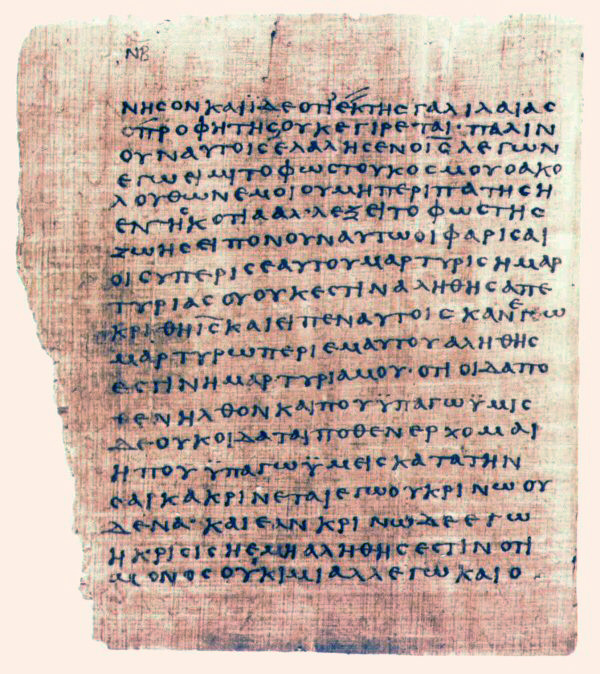
P66 (Papyrus Bodmer II) is a papyrus codex of the Gospel of John acquired by the Swiss collector Martin Bodmer in 1952 from a hoard of Coptic and Greek manuscripts found at Jabal Abu Mana in Upper Egypt — the same general find that yielded P72, P74, P75, and other Bodmer papyri, almost certainly from a monastic library. Victor Martin published the editio princeps in 1956. The codex contains nearly the entire Gospel of John: chapters 1-14 are nearly complete; chapters 15-21 survive in fragments. Six leaves are still attached to their original quires; the binding shows the codex was a single-quire production of unusual size. The dating of P66 has been debated almost since publication. Herbert Hunger's 1960 paleographic analysis put it as early as the late 2nd century, around AD 200; subsequent scholarship — Brent Nongbri's 2014 study most thoroughly — has argued the script is more comfortably 4th-century. The conservative middle position dates it to roughly AD 250-300. On any dating, P66 is one of the oldest substantial copies of any Gospel. The textual character of P66 is mixed: predominantly Alexandrian, with some Western readings and a number of singular variants. Most striking is the manuscript's heavy in-scribal correction. James Royse's analysis demonstrated the original copyist made many slips and immediately corrected himself, then a second corrector worked through against a careful exemplar. The result is a text that is sloppy on first writing but stabilized by the corrections — evidence of conscientious scribal practice even where the initial copying was hasty. The codex is at the Fondation Martin Bodmer in Cologny, Switzerland. Sources: Victor Martin, Papyrus Bodmer II: Évangile de Jean chap. 1-14 (1956); Brent Nongbri, "The Limits of Palaeographic Dating of Literary Papyri," Museum Helveticum 71 (2014); James Royse, Scribal Habits in Early Greek New Testament Papyri (2008); Philip W. Comfort and David P. Barrett, The Text of the Earliest New Testament Greek Manuscripts (2001).
Pushes the substantial text of John back to circa 200 AD. With P52 (~125), P66 (~200), and P75 (~225), John's text history is now traceable across the entire 2nd century.