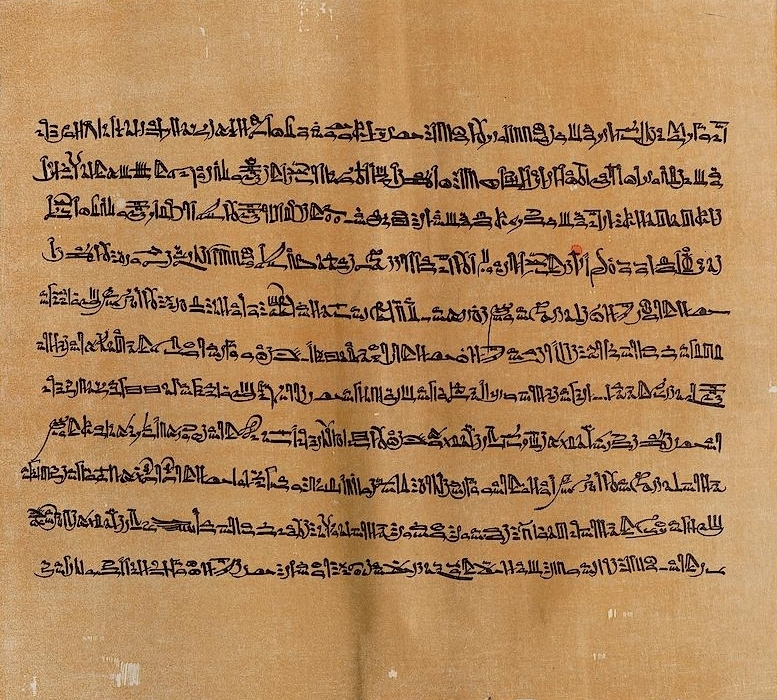
Papyrus Harris I was acquired for the British Museum in 1872 following its discovery at Medinet Habu near Thebes, Egypt, where it had been purchased from local dealers reportedly sourcing the document from the area of the royal necropolis at Deir el-Medina. The papyrus dates to shortly after the death of Ramesses III, conventionally placed around 1153 BC, having been composed in the early reign of Ramesses IV as a retrospective account of his predecessor's reign. It bears the British Museum registration number EA 9999 and remains in the museum's Egyptian collection in London. The document is the longest known ancient Egyptian papyrus, measuring approximately 41 meters in length and comprising 79 columns of hieratic text. It records temple endowments, administrative registers, and the military campaigns of Ramesses III, including his celebrated battles against coalitions of Sea Peoples — among them the Peleset, widely identified by Egyptologists including Kenneth Kitchen and Eliezer Oren with the biblical Philistines. The relevant sections describe Ramesses III settling defeated Sea Peoples in fortified strongholds along the Canaanite coast, corresponding archaeologically to the Philistine Pentapolis region referenced throughout the books of Judges and Samuel. For biblical study, Papyrus Harris I provides a fixed chronological anchor for Philistine settlement in Canaan, corroborating the scriptural portrayal of the Philistines as an organized, militarily capable population established along the coastal lowlands by the period of the Judges. The document also illuminates the socio-political conditions under which Israel's early tribal confederacy encountered well-equipped, recently displaced maritime peoples, enriching the historical backdrop of passages in 1 Samuel and the prophetic references in Amos 9:7 and Jeremiah 47:4. The papyrus remains a central exhibit in scholarly discussions of Late Bronze Age collapse and Iron Age I Levantine demography. **Sources:** Kenneth A. Kitchen, *Ramesside Inscriptions: Translated and Annotated* (Blackwell, 1996); Eliezer Oren, ed., *The Sea Peoples and Their World: A Reassessment* (University of Pennsylvania Museum, 2000); James Henry Breasted, *Ancient Records of Egypt*, vol. 4 (University of Chicago Press, 1906); 1 Samuel 4:1; Amos 9:7.
Papyrus Harris I provides the most detailed contemporary Egyptian account of the Sea Peoples invasions circa 1175 BC, situating the Philistines' settlement along Canaan's southern coast within a datable administrative record that directly contextualizes their emergence as Israel's adversaries in the biblical narrative.