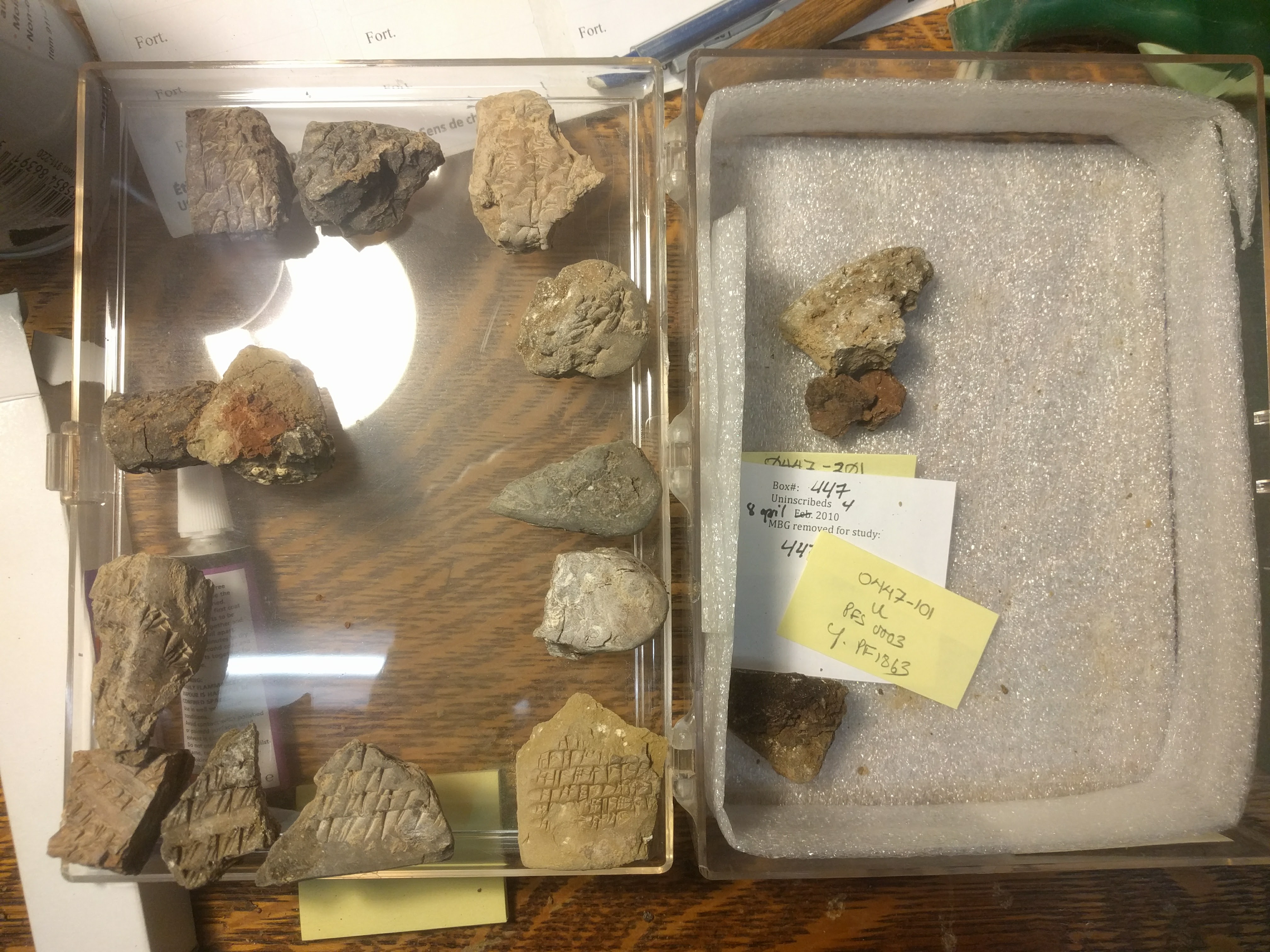
Excavated at Persepolis (Takht-e Jamshid) in southwestern Iran during the Oriental Institute's expedition led by Ernst Herzfeld between 1933 and 1934, the Fortification Tablets were recovered from a mudbrick storage complex on the northeastern terrace of the royal platform. Approximately 30,000 clay tablets and fragments were transported under permit to the Oriental Institute, University of Chicago, where the majority remain under catalog designations within the Persepolis Fortification Archive (PFA). A portion is retained by Iranian authorities. Elamite-language tablets dominate the corpus, with a smaller Aramaic component. The tablets are unbaked clay documents ranging from a few centimeters to roughly 10 cm in length, impressed with cuneiform script and administrative seal impressions. Dated internally to regnal years 13 through 28 of Darius I (509–494 BC), they record the disbursement of grain, wine, beer, and livestock to workers, officials, and travelers throughout the Achaemenid heartland. Personnel designations include scribes, craftsmen, livestock handlers, and foreign nationals—among them individuals identified as Yauna (Greeks) and, in some readings, groups associated with Judean or broader Levantine origins. Seal impressions have been studied extensively by Mark Garrison and Margaret Cool Root in their multi-volume catalog published by the Oriental Institute. For biblical scholarship, the tablets illuminate the administrative machinery described in Ezra and Nehemiah, where Persian royal decrees authorize and fund the Jerusalem temple's reconstruction and regulate the return of deportees. The ration-disbursement system attested at Persepolis corresponds directly to the kind of official provisioning implied by Artaxerxes' letter in Ezra 7:11–26. The archive also contextualizes the court setting of the book of Esther and corroborates the historical plausibility of Jewish officials operating within Achaemenid palatial bureaucracy. Ongoing epigraphic work continues to refine understanding of the archive's ethnic and geographic reach. **Sources:** Mark B. Garrison and Margaret Cool Root, *Seals on the Persepolis Fortification Tablets, Vol. 1* (Oriental Institute, 2001); Wouter Henkelman, *The Other Gods Who Are: Studies in Elamite-Iranian Acculturation* (Nederlands Instituut voor het Nabije Oosten, 2008); Peter Briant, *From Cyrus to Alexander: A History of the Persian Empire*, trans. P. Daniels (Eisenbrauns, 2002); Ezra 6:1-12; Ezra 7:11-26.
The Persepolis Fortification Tablets provide direct documentary evidence of Achaemenid imperial administration—the same bureaucratic apparatus that issued decrees permitting Jewish restoration under Cyrus, Darius, and Artaxerxes as recorded in Ezra and Nehemiah.