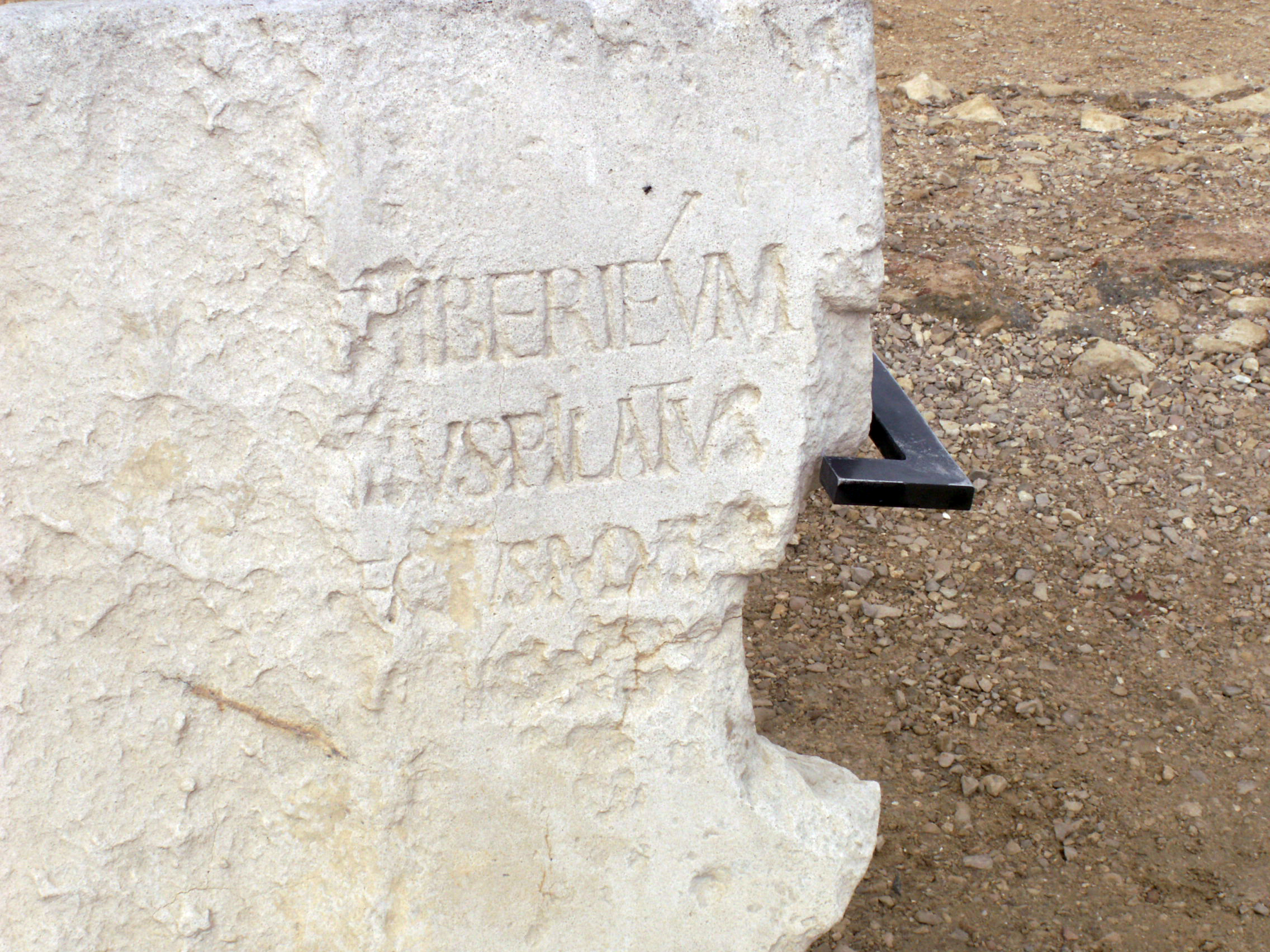
An Italian archaeological mission directed by Antonio Frova uncovered the limestone block in 1961 at Caesarea Maritima, reused as a step in the seating of the Herodian theater. The 32-by-26-inch stone had been recut for its second use, but four lines of a Latin dedicatory inscription remain partially legible: "[…]S TIBERIEUM / [PON]TIUS PILATUS / [PRAEF]ECTUS IUDA[EA]E / [REF]ECIT" — Pontius Pilate, prefect of Judaea, dedicated (or restored) a Tiberium, a temple in honor of the emperor Tiberius. The inscription dates to between AD 26 and 36, the years of Pilate's prefecture. This is the only contemporary inscriptional evidence for Pilate. Until the find, the prefect was known only from Josephus, Philo, Tacitus, and the Gospels. The stone confirms his historicity, his name, and his title. The title is itself important: Pilate is called praefectus, not procurator. Tacitus, writing eighty years later in Annals 15.44, called him procurator — the title of the office in his own day. The Caesarea inscription shows Tacitus updated the terminology; the Gospels use the looser hēgemōn ("governor"), which fits either rank. The Tiberium itself was a temple complex Pilate dedicated in the harbor city Herod the Great had built as Rome's administrative seat in Judaea. Caesarea is where Pilate ordinarily resided; he traveled to Jerusalem only for major festivals, including Passover. The original block is now in the Israel Museum, with a replica at the Caesarea site. Reading proposals continue to be debated; the identification with Pilate is secure. Sources: Antonio Frova, "L'iscrizione di Ponzio Pilato a Cesarea," Rendiconti Istituto Lombardo 95 (1961); Géza Alföldy, "Pontius Pilatus und das Tiberieum von Caesarea Maritima," Scripta Classica Israelica 18 (1999); Helen K. Bond, Pontius Pilate in History and Interpretation (1998); Joan E. Taylor, "Pontius Pilate and the Imperial Cult in Roman Judaea," NTS 52 (2006).
Direct extra-biblical confirmation that Pontius Pilate was a real Roman official governing Judea at the time the Gospels place him there, with the exact title (prefect, not procurator) the Gospels imply. Settled a long-running skeptical question about Pilate's historicity.