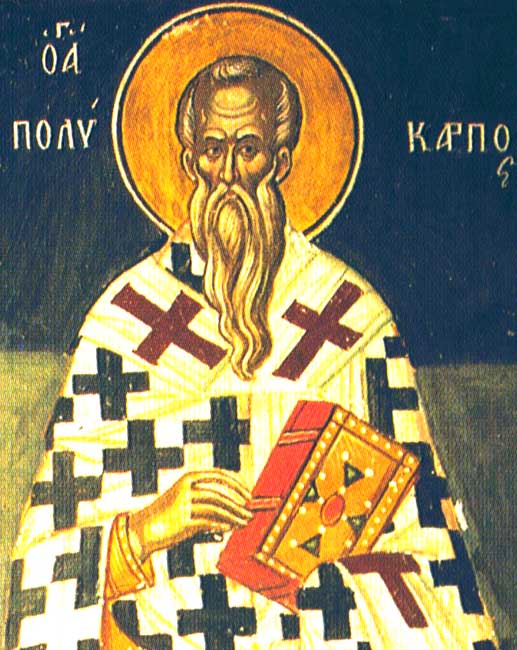
The Martyrdom of Polycarp is a letter from the church at Smyrna to the church at Philomelium in Phrygia, written within months of the bishop's death — the colophon dates the events to the second day of the month Xanthikos, which corresponds to a Saturday in late February. The traditional date is AD 156, though Timothy Barnes's 1967 redating to AD 167 has gained ground; the underlying chronology depends on the proconsulship of Statius Quadratus, otherwise unattested. The letter circulated rapidly across the Mediterranean and was preserved by Eusebius of Caesarea in the fourth book of his Ecclesiastical History. The narrative is concrete and unhurried. Polycarp, eighty-six years old and bishop of Smyrna for decades, was hunted out of a country house at the urging of the festival crowd. Brought to the stadium, he was offered release if he would swear by Caesar's fortune and revile Christ. He answered with the line that has shaped Christian martyrology since: "Eighty and six years have I served Him, and He has done me no wrong; how then can I blaspheme my King who saved me?" He was tied to the stake — the executioners did not bother to nail him, on his word that he would not flinch — and burned. When the fire would not consume him, he was stabbed. The text is the earliest surviving martyr-account outside the New Testament. Its careful framing — patterned deliberately on the passion of Christ — set the genre's template. Some scholars (notably Hans von Campenhausen) have argued for later interpolations; the broad authenticity of the core narrative is the consensus. Sources: Eusebius, Ecclesiastical History 4.15 (Loeb ed., trans. Kirsopp Lake); J. B. Lightfoot, The Apostolic Fathers, Part II, vol. 3 (1885); Timothy D. Barnes, "A Note on Polycarp," JTS 18 (1967); Sara Parvis, "The Martyrdom of Polycarp," in Paul Foster, ed., The Writings of the Apostolic Fathers (2007).
Direct evidence that Christians of the mid-2nd century would die rather than affirm Caesar as Lord. Polycarp's words at trial — "Eighty-six years I have served Him, and He never did me any wrong; how then can I blaspheme my King who saved me?" — remain a foundational Christian text.