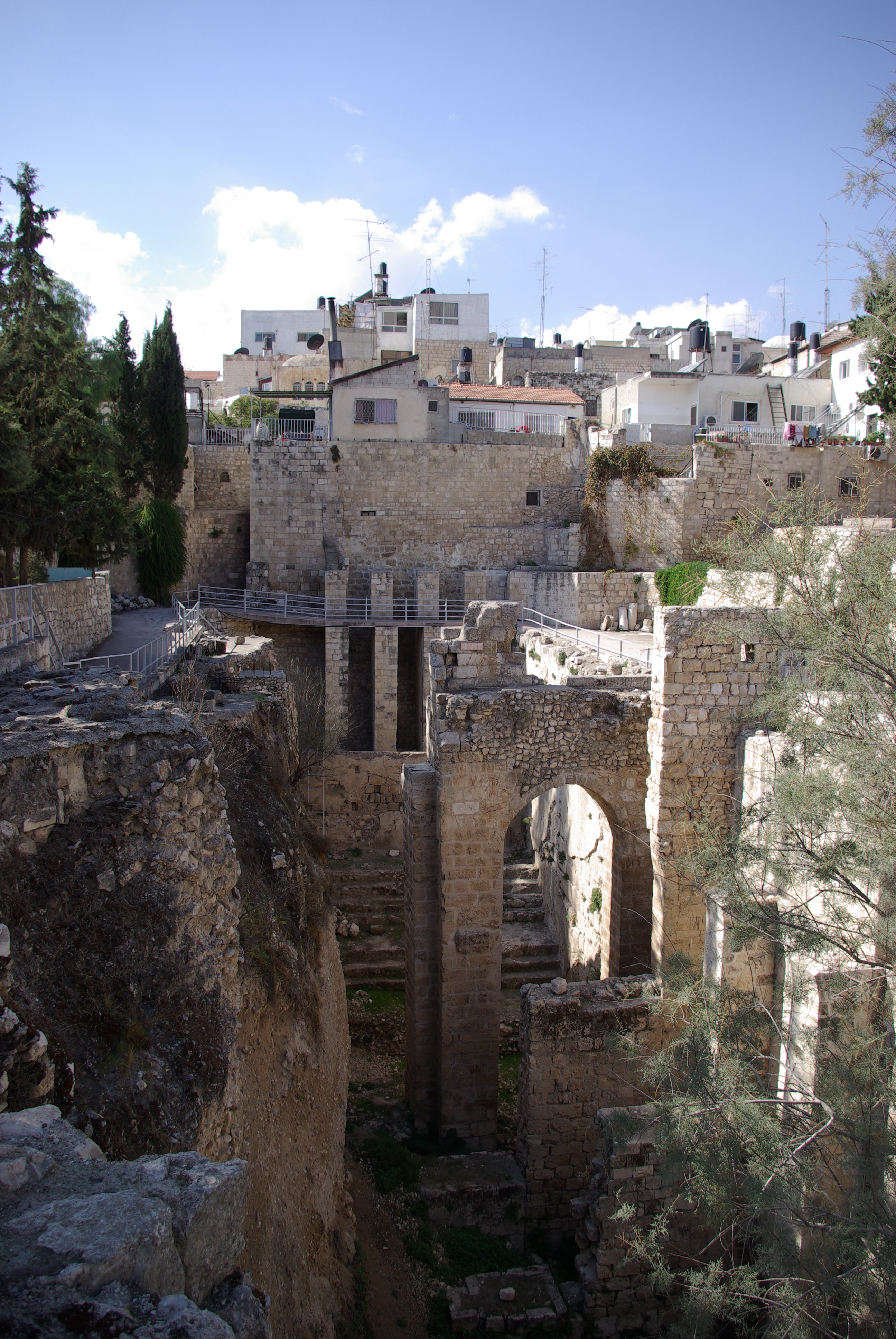
The Gospel of John 5:2 places the healing of the paralytic "by the Sheep Gate a pool, in Aramaic called Bethesda, with five porticoes." For centuries the verse was read by skeptics — and by some commentators — as evidence the Gospel was composed by someone unfamiliar with first-century Jerusalem; no such pool was known and the geometry of "five porticoes" seemed impossible. The five-portico description fit no Greco-Roman public pool of which any record survived. Excavations beginning under the White Fathers in the 1880s and continuing into the late 20th century, eventually directed by Joachim Jeremias and others, uncovered north of the Temple Mount a twin-basin pool. Two large rectangular basins lay side by side, separated by a partition wall. Porticoes ran around the four exterior sides, and a fifth ran across the dividing wall between the two basins. The five porticoes John mentions are the four around the perimeter plus the one bisecting the complex — exactly the configuration the Gospel describes. The pools were originally built in the 8th century BC for water storage and were expanded in the Hellenistic period. By the 1st century AD the southern pool had become a mikveh-like ritual installation; healing reputations of similar pools elsewhere — and the Asclepius shrine that occupied the site after AD 135 — suggest a continuing therapeutic association. The site is now within the precincts of the Crusader-era Church of St. Anne in the Muslim Quarter of the Old City of Jerusalem, the foundations visible to visitors. The text and the topography agree. Sources: Urban C. von Wahlde, "The Pool of Bethesda and the Gospel of John," in Jesus and Archaeology (2006); Shimon Gibson, The Final Days of Jesus (2009); Joachim Jeremias, The Rediscovery of Bethesda (1966); James H. Charlesworth, ed., Jesus and Archaeology (2006).
A textbook case of an archaeological discovery vindicating a Gospel detail dismissed as fictional. John's author knew pre-70 AD Jerusalem firsthand — including a pool buried under rubble for centuries afterward.