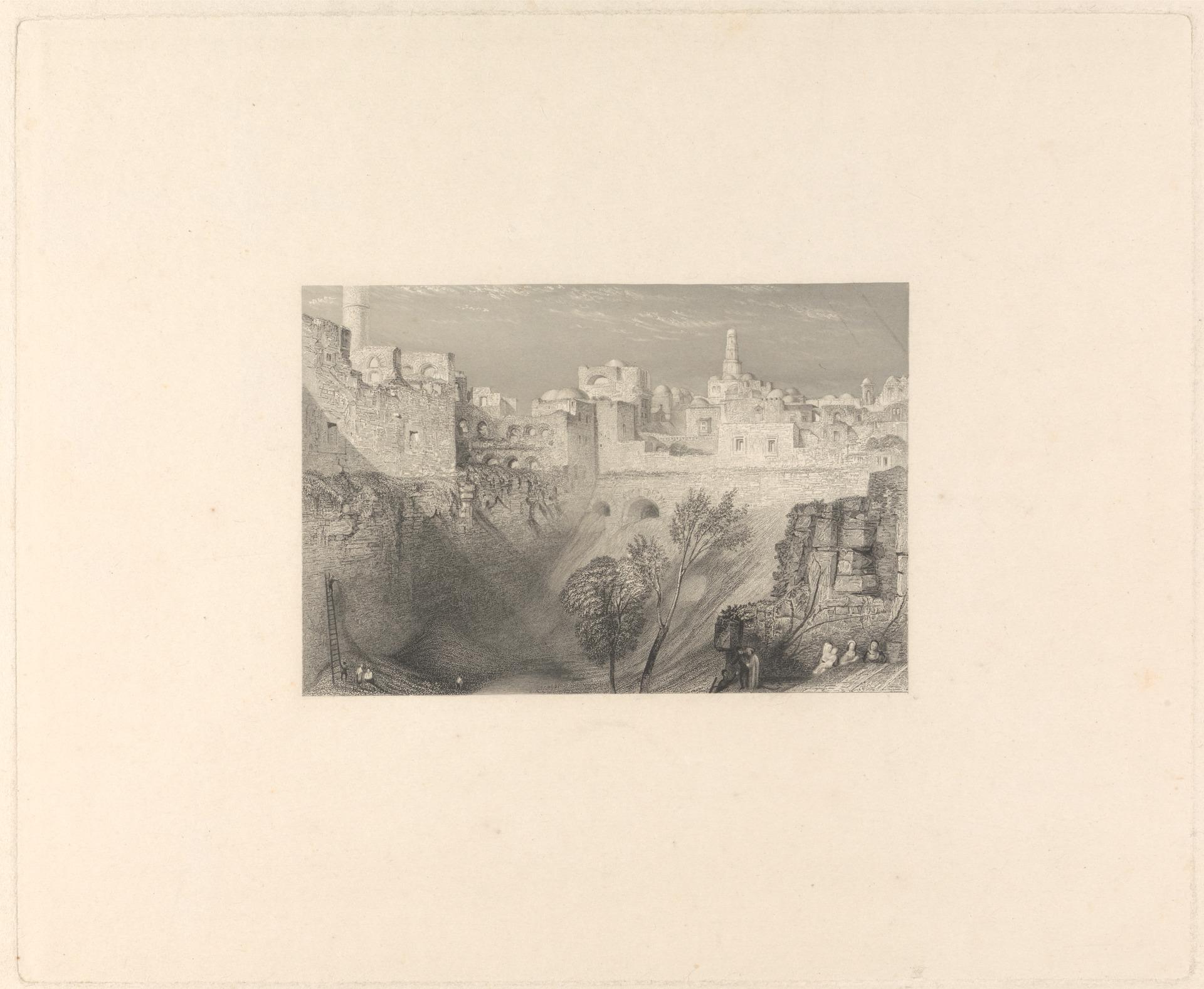
The pool complex now identified with Bethesda lies in the northeastern corner of the Old City of Jerusalem, beneath and adjacent to the Church of Saint Anne. Systematic archaeological investigation began in the late nineteenth century under the direction of scholars associated with the White Fathers (Assumptionist Fathers), who hold the site. Further clarifying work was conducted in the mid-twentieth century, including studies by Pierre Benoit and the École Biblique et Archéologique Française. The site is preserved in situ and remains accessible to researchers, with associated ceramic and architectural evidence held by the Israel Antiquities Authority. Excavations revealed two large, trapezoidal reservoirs separated by a central rock-cut dam or partition, producing five distinct colonnaded porches when the surrounding four outer porticoes and the central dividing one are counted together — a configuration that corresponds precisely to the Johannine description of five stoas (John 5:2). The twin basins measure roughly 50 by 90 metres in total. Stratigraphy indicates the northern reservoir functioned as early as the eighth to seventh centuries BC as a water-collection system, while the southern basin and surrounding portico infrastructure were elaborated during the Hasmonean and Herodian periods. Votive offerings, small pools suited to ritual immersion, and later Roman-period dedications to Asclepius attest to the site's use as a therapeutic venue well into the first and second centuries AD. The archaeological record at Bethesda significantly advances the textual criticism and historical geography of the Fourth Gospel. Scholars had once questioned whether the five-porticed pool was a Johannine theological construct rather than a real location, given the absence of corroborating ancient sources. The excavated twin-basin plan with its five colonnaded divisions resolves that debate within the mainstream of Johannine scholarship, confirming that the evangelist worked with accurate knowledge of Jerusalem's pre-destruction topography. The site also contextualizes healing accounts within the broader phenomenon of Greco-Roman therapeutic pools, illuminating the cultural setting of John 5. **Sources:** Pierre Benoit, "Découvertes archéologiques autour de la piscine de Béthesda," in *Jerusalem Through the Ages* (Israel Exploration Society, 1968); Joachim Jeremias, *The Rediscovery of Bethesda* (Southern Baptist Theological Seminary Press, 1966); Urban C. von Wahlde, "Archaeology and John's Gospel," in *Jesus and Archaeology*, ed. James H. Charlesworth (Eerdmans, 2006); John 5:1-15.
Excavations beneath the Church of Saint Anne exposed a large twin-basin pool complex matching John 5's description of five porticoes, demonstrating that the Fourth Gospel preserves accurate topographical memory of pre-70 AD Jerusalem rather than purely symbolic architecture.