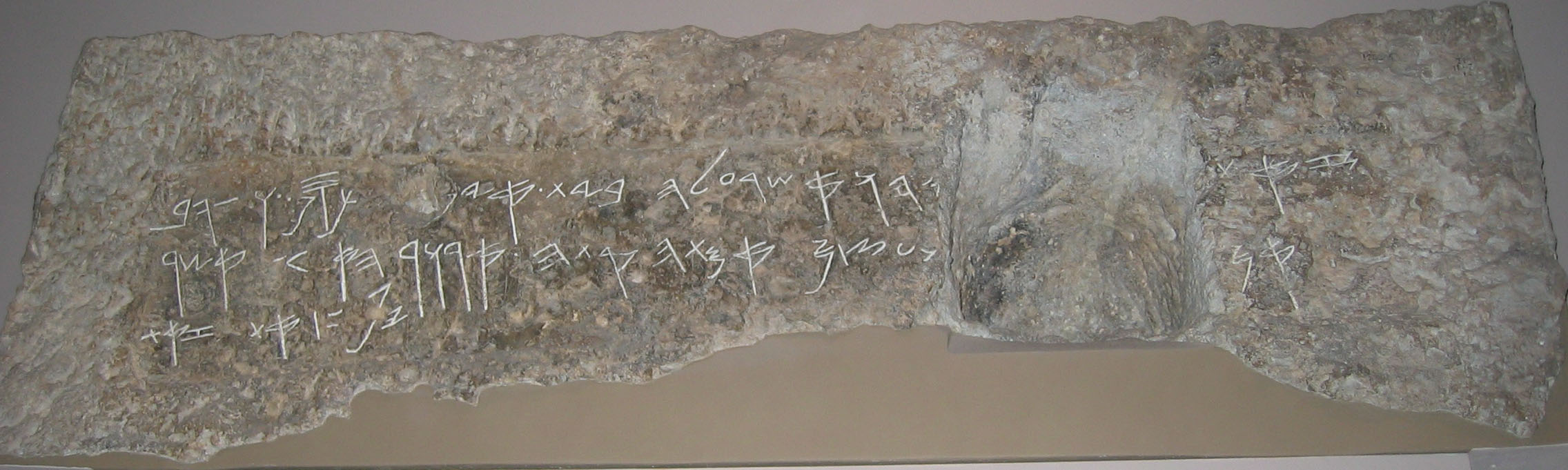
The Royal Steward Inscription is a carved limestone tomb lintel discovered in the rock-cut necropolis at Silwan (ancient Siloam Village), on the eastern slope of the Kidron Valley opposite the City of David in Jerusalem. It was removed from its original context in the nineteenth century and is now housed in the British Museum (BM 125205). Epigraphically dated to approximately 700 BC on paleographic grounds, the lintel preserves a partially damaged Hebrew inscription in Old Hebrew script. The surviving text reads, in substance: 'This is [the tomb of …]-yahu who is over the house. There is no silver and no gold here, only [his bones] and the bones of his slave-wife with him. Cursed be the man who opens this.' The owner's personal name is largely broken away; only the theophoric suffix '-yahu' survives. Nahman Avigad's landmark 1953 analysis demonstrated that the title 'who is over the house' (Hebrew: 'asher 'al ha-bayit) is the standard designation for a senior royal steward or majordomo of the Judahite court. Avigad further proposed that the tomb's occupant is likely Shebna (full form: Shebna-yahu), the official whom the prophet Isaiah rebukes in Isaiah 22:15–16 for 'hewing out a tomb on the height' and 'cutting a habitation for himself in the rock.' The geographical proximity to Jerusalem, the period, and the matching title make this identification plausible, though the damaged name prevents certainty, and some scholars urge caution. The inscription materially attests the existence of senior administrative officials holding this precise title in late monarchic Judah and corroborates the social and funerary practices presupposed by the Isaiah passage. Sources: British Museum collection record (BM 125205); N. Avigad, 'The Epitaph of a Royal Steward from Siloam Village,' Israel Exploration Journal 3 (1953); J. C. L. Gibson, Textbook of Syrian Semitic Inscriptions, vol. 1 (1971).
The Silwan lintel provides direct epigraphic evidence for the title and funerary customs of high royal officials in late Iron Age Judah, and it offers the closest known material correlate—though not a confirmed identification—for the official Shebna condemned by name in Isaiah 22.