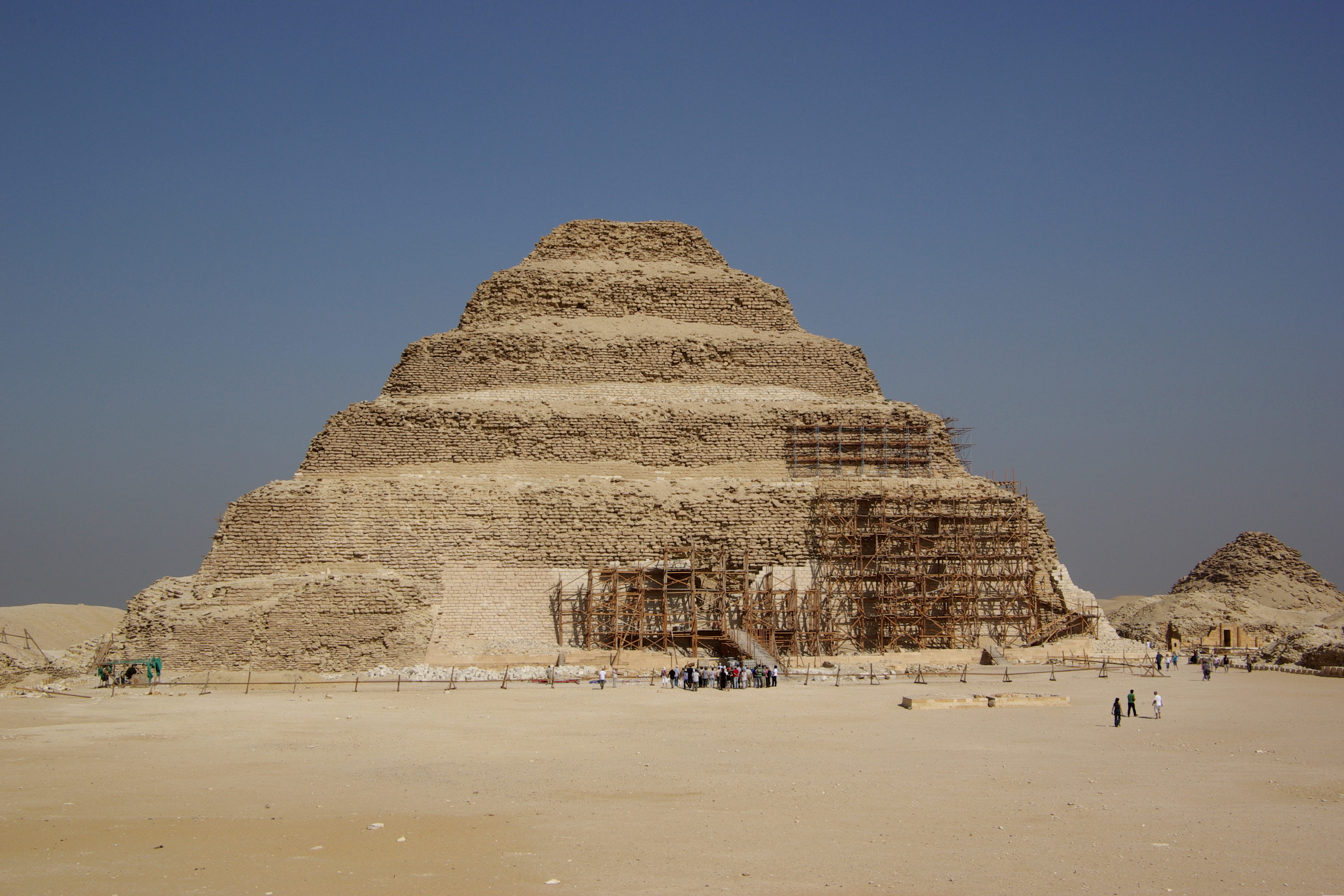
The Step Pyramid complex at Saqqara, located approximately 30 kilometers south of modern Cairo, was excavated systematically beginning in the late nineteenth century, with definitive clearance and study conducted by Jean-Philippe Lauer starting in 1926 and continuing for several decades. Lauer's meticulous architectural analysis, published across numerous volumes through the Institut français d'archéologie orientale, remains the foundational reference for the site. The complex is preserved in situ at the Saqqara necropolis, while portable objects recovered from associated subterranean galleries — including faience tiles and stone vessels bearing Djoser's Horus name — are held primarily at the Egyptian Museum, Cairo. Constructed under the Third Dynasty pharaoh Djoser (reigned c. 2667–2648 BC) and attributed by ancient Egyptian sources to the architect Imhotep, the Step Pyramid rises approximately 62 meters across a roughly rectangular base of 121 by 109 meters. It represents the first deliberate use of cut limestone ashlar in a monumental architectural program, superseding earlier mudbrick mastaba forms. The surrounding funerary precinct spans roughly 15 hectares and incorporates courts, shrines, and a mortuary temple — collectively demonstrating sophisticated state organization, specialized labor administration, and a developed theology of royal afterlife. These administrative and theological structures are precisely the institutional matrix that Genesis 41 and 50 and Exodus 1 presuppose when situating Israelite figures within Egyptian court and burial practice. For biblical study, the Step Pyramid complex substantiates the antiquity and organizational complexity of Egyptian civilization centuries before the conventionally dated patriarchal period. It demonstrates that the embalming practices described in Genesis 50:2–3, the royal court structures of Genesis 41, and the large-scale state construction projects referenced in Exodus 1:11 all reflect practices embedded in a long and materially documented Egyptian institutional tradition. The complex thus provides an archaeologically grounded framework within which the biblical portrait of Egypt can be critically examined and contextualized. **Sources:** Jean-Philippe Lauer, *La Pyramide à degrés: L'Architecture* (Institut français d'archéologie orientale, 1936); I. E. S. Edwards, *The Pyramids of Egypt*, rev. ed. (Penguin, 1993); James K. Hoffmeier, *Israel in Egypt: The Evidence for the Authenticity of the Exodus Tradition* (Oxford University Press, 1997); Genesis 41:41, Genesis 50:2, Exodus 1:11.
As the earliest large-scale dressed-stone complex in the ancient world, the Saqqara Step Pyramid establishes the architectural, administrative, and mortuary capacities of Old Kingdom Egypt, providing indispensable material context for the patriarchal and Exodus narratives set within Egyptian civilization.