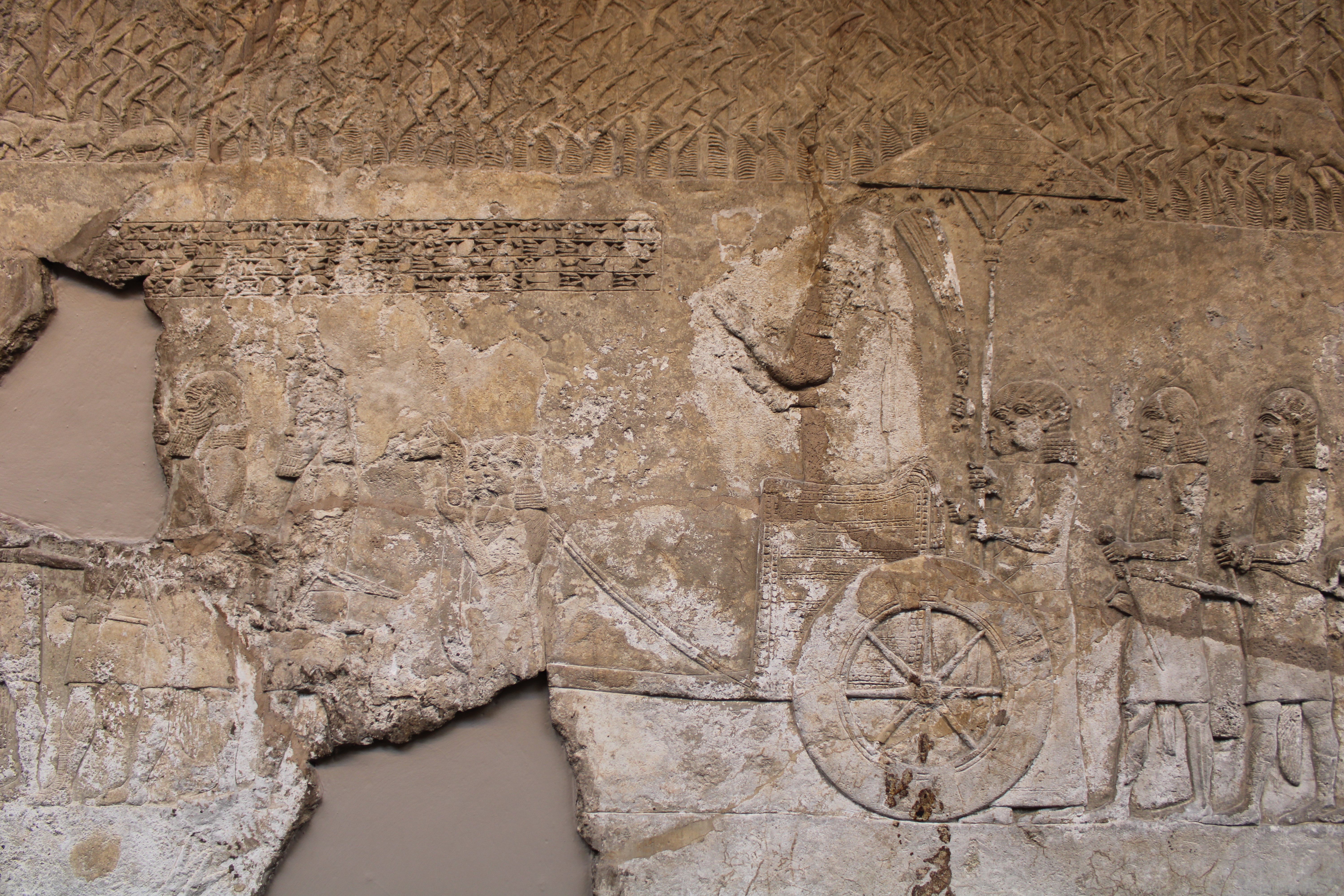
The colossal human-headed winged bulls (lamassu) erected at Sennacherib's Southwest Palace at Nineveh bore cuneiform inscriptions constituting one of several recensions of his royal annals. Excavations at Nineveh (ancient Kuyunjik) conducted by Austen Henry Layard from 1847 onward, and subsequently by Hormuzd Rassam, recovered both the palace architecture and multiple annal exemplars. The bull inscription recension represents an earlier compositional layer than the later Rassam Cylinder, with key exemplars now held at the Oriental Institute Museum, Chicago, and the British Museum, London, catalogued within the broader Kuyunjik collection. The inscriptions are carved in Neo-Assyrian cuneiform on calcite alabaster surfaces of the lamassu figures, standing approximately four to five meters in height. The relevant campaign account describes Sennacherib's advance through the Levant during his third campaign (c. 701 BC), listing the subjugation of Phoenician cities, the defeat of an Egyptian-backed coalition at Eltekeh, the capture of Lachish and 46 other Judahite fortified cities, and the deportation of over 200,000 people. Hezekiah of Jerusalem is described as shut up "like a bird in a cage" within his capital — a formulation paralleled across recensions — with tribute enumerated in detail. The text does not record a conquest of Jerusalem, an absence that aligns with the biblical narrative's account of Assyrian withdrawal (2 Kings 19:35–36; Isaiah 37:36–37). For biblical scholarship, the Bull Inscription recension is significant as an alternative textual witness to the same events, allowing scholars to trace how Assyrian scribal tradition edited and expanded the campaign account across successive compositions. The account corroborates the historicity of Hezekiah's reign, the Assyrian invasion of Judah, and the siege context described in 2 Kings 18–19 and Isaiah 36–37, while the non-capture of Jerusalem remains a point of sustained comparative analysis between the two traditions. **Sources:** A. Kirk Grayson and Jamie Novotny, *The Royal Inscriptions of Sennacherib, King of Assyria (704–681 BC), Part 1* (Eisenbrauns, 2012); Daniel David Luckenbill, *The Annals of Sennacherib* (University of Chicago Press, 1924); William R. Gallagher, *Sennacherib's Campaign to Judah: New Studies* (Brill, 1999); 2 Kings 18:13–19:37.
The Bull Inscription recension offers an independent Assyrian account of Sennacherib's 701 BC campaign against Judah and Hezekiah, corroborating core details in Kings and Isaiah while preserving divergences that illuminate the literary conventions of both traditions.