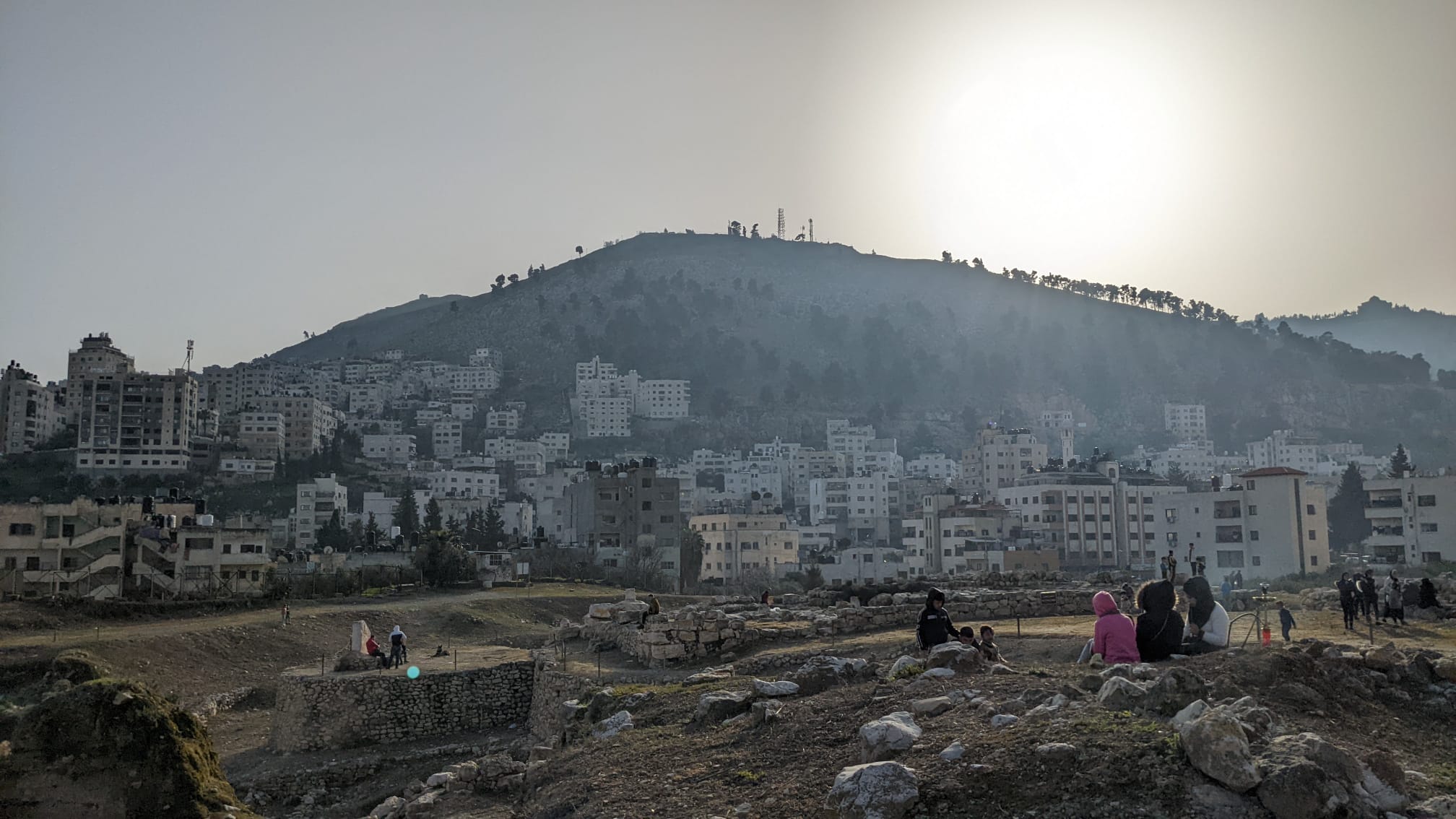
Tell Balata, located at the eastern edge of modern Nablus in the West Bank, is the site of ancient Shechem, situated in the pass between Mt. Ebal and Mt. Gerizim. Systematic excavations were conducted by Ernst Sellin and Georg Welter in the 1920s–1930s, followed by G. Ernest Wright and the Drew-McCormick expedition from 1956–1973, establishing a continuous occupation sequence stretching from the Middle Bronze Age IIA (roughly 1900 BC) through the Iron Age II, ending with Assyrian destruction circa 724–722 BC. The site preserves substantial architectural remains including a massive migdal (fortress) temple — one of the largest Canaanite temples yet excavated — city walls with a well-preserved gate complex, and evidence of multiple destruction and rebuilding phases. Shechem figures prominently in the patriarchal narratives: Genesis 12:6 places Abram at 'the oak of Moreh' near Shechem; Genesis 33:18–20 records Jacob purchasing land and erecting an altar there, designating it El-Elohe-Israel. The city later served as the site of Joshua's covenant renewal assembly (Joshua 24:1), a passage set against Shechem's role as a tribal and cultic center consistent with its archaeological prominence. First Kings 12:1 situates the fateful assembly at which the united monarchy fractured in Shechem, though Jeroboam I subsequently moved his capital to Tirzah. Archaeology confirms the city's regional dominance during the Middle and Late Bronze Ages, its decline and partial recovery in the Iron Age, and an eventual violent termination consistent with Assyrian campaigns in the northern kingdom. No inscription directly naming Shechem has been recovered from the tell itself, but the site appears in Egyptian execration texts and the Amarna letters as Šakmu. Sources: Harvard Semitic Museum (Wright expedition archives); G. E. Wright, Shechem: The Biography of a Biblical City (1965); E. F. Campbell & J. F. Ross, 'The Excavation of Shechem,' Biblical Archaeologist 26 (1963); Lawrence E. Toombs, NEAEHL vol. 4.
Tell Balata provides one of the most thoroughly excavated urban sequences in the central hill country, materially grounding Shechem's recurring role as a covenant, tribal, and political center across the patriarchal, conquest, and monarchic periods attested in the Hebrew Bible. Its fortress-temple and gate complex illuminate the kind of fortified Canaanite urban environment presupposed by the Genesis and Joshua narratives without functioning as direct confirmation of specific patriarchal events.