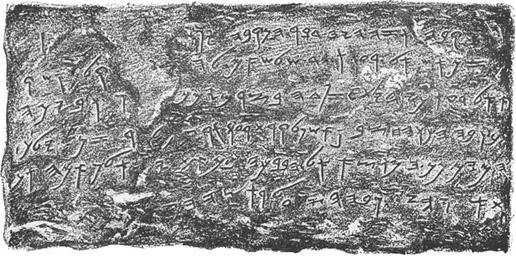
The Siloam Inscription was discovered in June 1880 by a sixteen-year-old named Jacob Eliahu — a student of the American Colony school in Jerusalem — who was wading through Hezekiah's Tunnel near its southern end and noticed letters cut into the rock wall about twenty feet above the Pool of Siloam outlet. The inscription, six lines in paleo-Hebrew, was the first substantial monumental inscription in the Hebrew language to be recovered from the biblical period. The script is firmly dated to the late 8th century BC. The text describes the meeting of two crews of tunnelers, hacking from opposite ends through 1,750 feet of solid limestone, when they finally heard one another through the rock. The inscription reads in part: "while there were yet three cubits to be cut through, [each heard] the voice of a man calling to his neighbor, for there was a fissure in the rock on the right hand. And on the day of the breach the stonecutters struck, each man toward his neighbor, ax against ax, and the water flowed from the source to the pool 1,200 cubits, and 100 cubits was the height of the rock above the heads of the stonecutters." The inscription is unique in surviving West Semitic epigraphy: it commemorates not a king's deeds but the workmen's. No royal name appears. The slab was cut from the tunnel wall in 1890 by an antiquities dealer; Ottoman authorities seized it and transported it to Constantinople, where it remains in the Istanbul Archaeological Museum despite repeated requests for repatriation to Jerusalem. A modern reproduction sits at the original spot. Sources: A. H. Sayce, "The Inscription at the Pool of Siloam," PEFQS (1881); P. Kyle McCarter Jr., Ancient Inscriptions: Voices from the Biblical World (1996); Frank M. Cross, "The Stem of Jesse," in Leaves from an Epigrapher's Notebook (2003); Gabriel Barkay, "The Siloam Inscription," in The Israel Museum's Collection Online.
One of the longest and oldest examples of pre-exilic Hebrew. Confirms 2 Kings 20:20 in the engineers' own voices and uses authentic 8th-century BC Hebrew vocabulary and grammar.