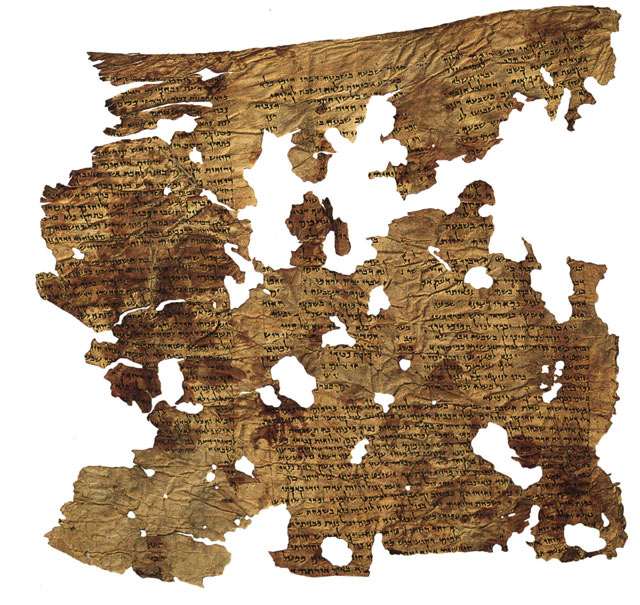
The Songs of the Sabbath Sacrifice survive in nine copies recovered from Cave 4 at Qumran (4Q400–407) during excavations led by Roland de Vaux between 1952 and 1956, with a tenth copy found at Cave 11 (11Q17) and an eleventh fragmentary exemplar uncovered at Masada by Yigael Yadin in 1963–1965. The Qumran fragments were first systematically analyzed by John Strugnell in the 1960s, and the editio princeps was produced by Carol Newsom in the Discoveries in the Judaean Desert series (DJD XI, 1998). Principal manuscript holdings are maintained by the Israel Antiquities Authority, with digitized images accessible through the Leon Levy Dead Sea Scrolls Digital Library. The composition comprises thirteen discrete songs, one for each Sabbath of the first quarter of the liturgical year, written in Hebrew on parchment. The extant fragments span multiple columns and display a dense, repetitive rhetorical style characteristic of liturgical heightening. The songs describe angelic priests officiating in a celestial temple, the movements of the merkavah (divine chariot-throne), the praise of seven deputy princes, and the sounds and structures of the heavenly sanctuary. These descriptions engage directly with the visionary traditions of Ezekiel 1 and 10, elaborating the cherubim, wheels, and throne-platform in terminological detail not found in the Hebrew Bible itself. For biblical scholarship, the Songs illuminate the exegetical and liturgical reception of Ezekiel's chariot vision and Isaiah's throne-room call narrative within a pre-rabbinic sectarian community, confirming that merkavah speculation was already sophisticated before the destruction of the Second Temple in AD 70. The texts also provide important comparative material for understanding the heavenly-worship sequences in Revelation 4–5, situating those New Testament passages within a documented Jewish literary tradition rather than treating them as sui generis. The Masada copy, predating the site's fall in AD 73, establishes that the composition circulated beyond the Qumran community. **Sources:** Carol Newsom, *Songs of the Sabbath Sacrifice: A Critical Edition* (Scholars Press, 1985); Florentino García Martínez and Eibert J. C. Tigchelaar, *The Dead Sea Scrolls Study Edition*, 2 vols. (Brill/Eerdmans, 1997–1998); James R. Davila, *Liturgical Works* (Eerdmans, 2000); Ezekiel 1:1-28; Isaiah 6:1-3.
The Songs of the Sabbath Sacrifice represent the earliest extended description of heavenly liturgy in Jewish literature, providing direct comparative context for the divine-council imagery in Ezekiel, Isaiah 6, and the throne-room texts that shaped New Testament apocalyptic.