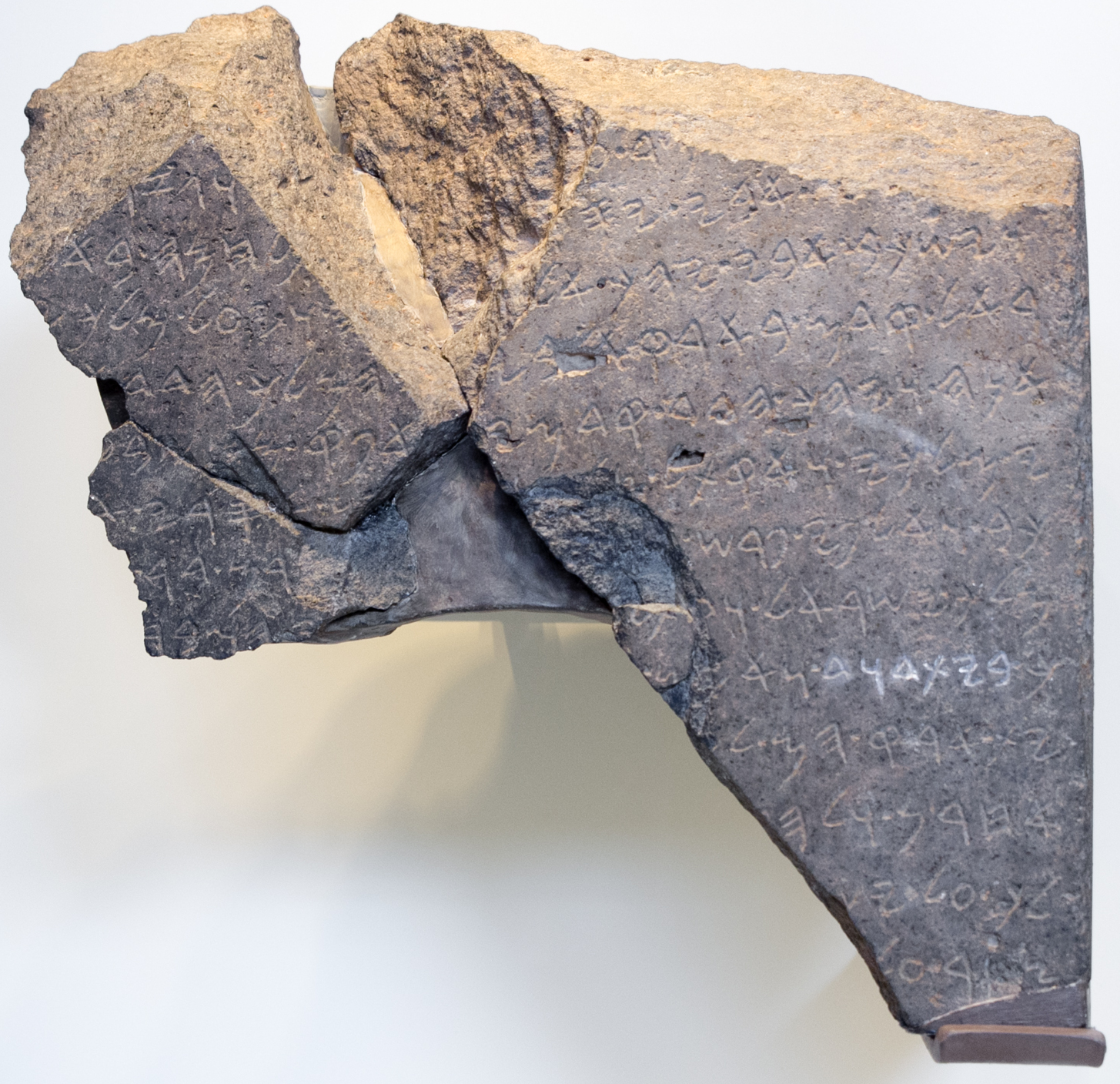
In July 1993, a survey team led by Avraham Biran at Tel Dan in northern Israel uncovered a fragment of inscribed basalt reused as paving in the Iron Age gate complex. Two further pieces emerged the following year. Reassembled, the fragments preserve thirteen lines of an Aramaic victory inscription erected by an Aramean king — most likely Hazael of Damascus — boasting of victories over kings of Israel and Judah, including a "[Jeho]ram son of [Ahab]" and an "[Ahaz]iah son of [Jehoram]." The decisive phrase appears in line 9: "BYTDWD" — bytdwd, "House of David." Until 1993, the name David had not appeared in any inscription outside the Bible, and a vocal minority of scholars — Philip Davies, Thomas L. Thompson, Niels Peter Lemche — had argued that David was a literary fiction with no historical kingdom behind it. The Tel Dan stele names the southern kingdom by its dynastic founder a century and a half after David's lifetime, exactly as a contemporary Aramean king would refer to a neighboring power. The inscription dates to the second half of the 9th century BC. A handful of scholars proposed alternative readings — André Lemaire suggested bytdwd at line 31 of the Mesha Stele likewise, strengthening rather than contradicting the Tel Dan reading. The consensus among epigraphers is that the phrase reads "House of David" and that the Davidic dynasty was a recognized political entity in the 9th century BC. The fragments are on display at the Israel Museum. Sources: Avraham Biran and Joseph Naveh, "An Aramaic Stele Fragment from Tel Dan," IEJ 43 (1993) and "The Tel Dan Inscription: A New Fragment," IEJ 45 (1995); André Lemaire, "'House of David' Restored in Moabite Inscription," BAR 20:3 (1994); Hallvard Hagelia, The Tel Dan Inscription: A Critical Investigation of Recent Research (2006).
Until 1993, skeptics routinely argued David was a legendary figure with no historical basis. The Tel Dan Stele settled the debate within mainstream scholarship: the Davidic dynasty was real and recognized as such by Israel's neighbors within 150 years of David's reign.