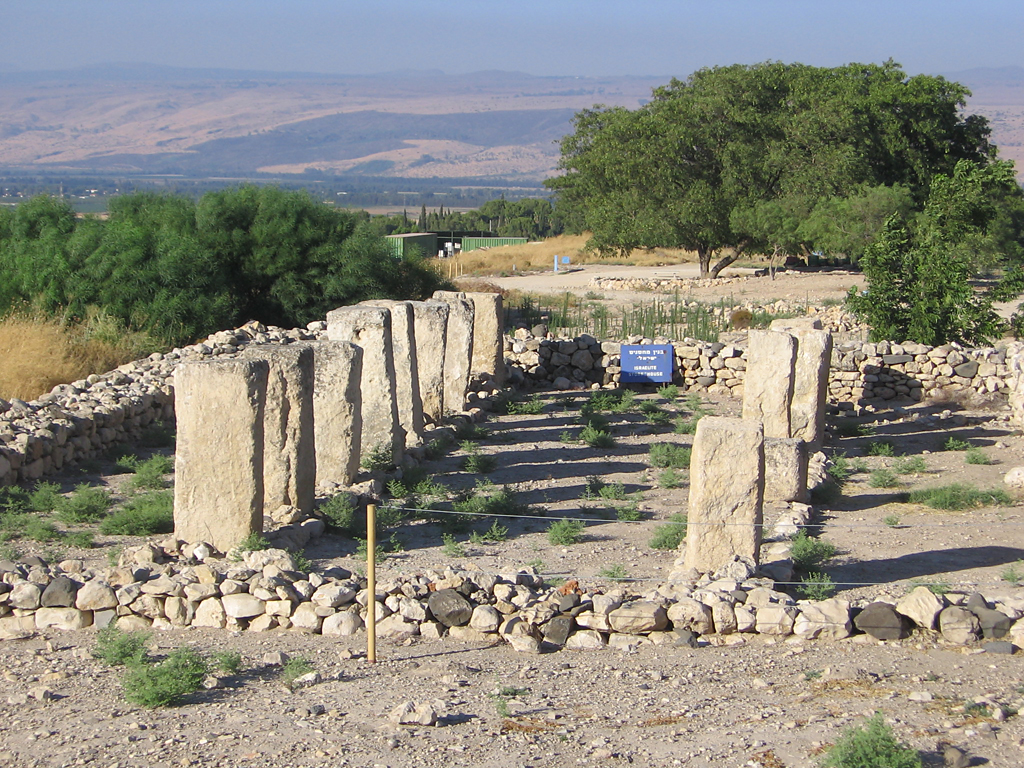
Tel Hazor sits at the northern end of the Hula Valley, fifteen kilometers north of the Sea of Galilee — the largest tell in modern Israel and, in the Late Bronze Age, the largest Canaanite city in the southern Levant at roughly 200 acres including the lower city. Joshua 11:10 calls it "the head of all those kingdoms," and the Mari archive correspondence and the Amarna letters confirm Hazor as a major regional power in independent Egyptian and Mesopotamian sources from the eighteenth and fourteenth centuries BC. Yigael Yadin led the Hebrew University expedition there from 1955 to 1958 and again in 1968; Amnon Ben-Tor of the Hebrew University has directed the renewed Selz Foundation Hazor Excavations since 1990, and the dig continues. The Late Bronze Age city ended in a violent conflagration in the thirteenth century BC — a destruction layer of charred mudbrick, smashed cult statues with their faces deliberately mutilated, and burnt floors up to a meter thick. Whether this destruction matches Joshua 11:13 — "only Hazor did Joshua burn" — is a live and contested question. Ben-Tor argues for an Israelite agent on the basis of the deliberate iconoclasm; others read the destruction as one episode in the broader Late Bronze collapse. The dispute is honest and ongoing. Above the destruction, a six-chambered city gate of the same plan as those at Megiddo and Gezer (1 Kings 9:15) was assigned by Yadin to the tenth century BC, anchoring the archaeological signature of Solomonic-era construction. A cuneiform archive of eighteen Akkadian tablets has been recovered from the site over the seasons — administrative, juridical, and lexical texts. Hazor is a UNESCO World Heritage Site; the finds are housed at the Israel Museum, Jerusalem. Sources: Yigael Yadin, Hazor: The Rediscovery of a Great Citadel of the Bible (Random House, 1975); Amnon Ben-Tor, Hazor: Canaanite Metropolis, Israelite City (Israel Exploration Society, 2016); Amnon Ben-Tor and Maria Teresa Rubiato, "Excavating Hazor" (Biblical Archaeology Review 25, 1999); Joshua 11:10–13.
Hazor anchors three distinct layers of biblical-archaeological inquiry simultaneously: the Joshua conquest narratives, the Solomonic building program of 1 Kings 9:15, and the broader question of Canaanite urban scale. Its corroboration in Mari and Amarna texts makes it uniquely cross-referenced in Near Eastern documentary evidence.