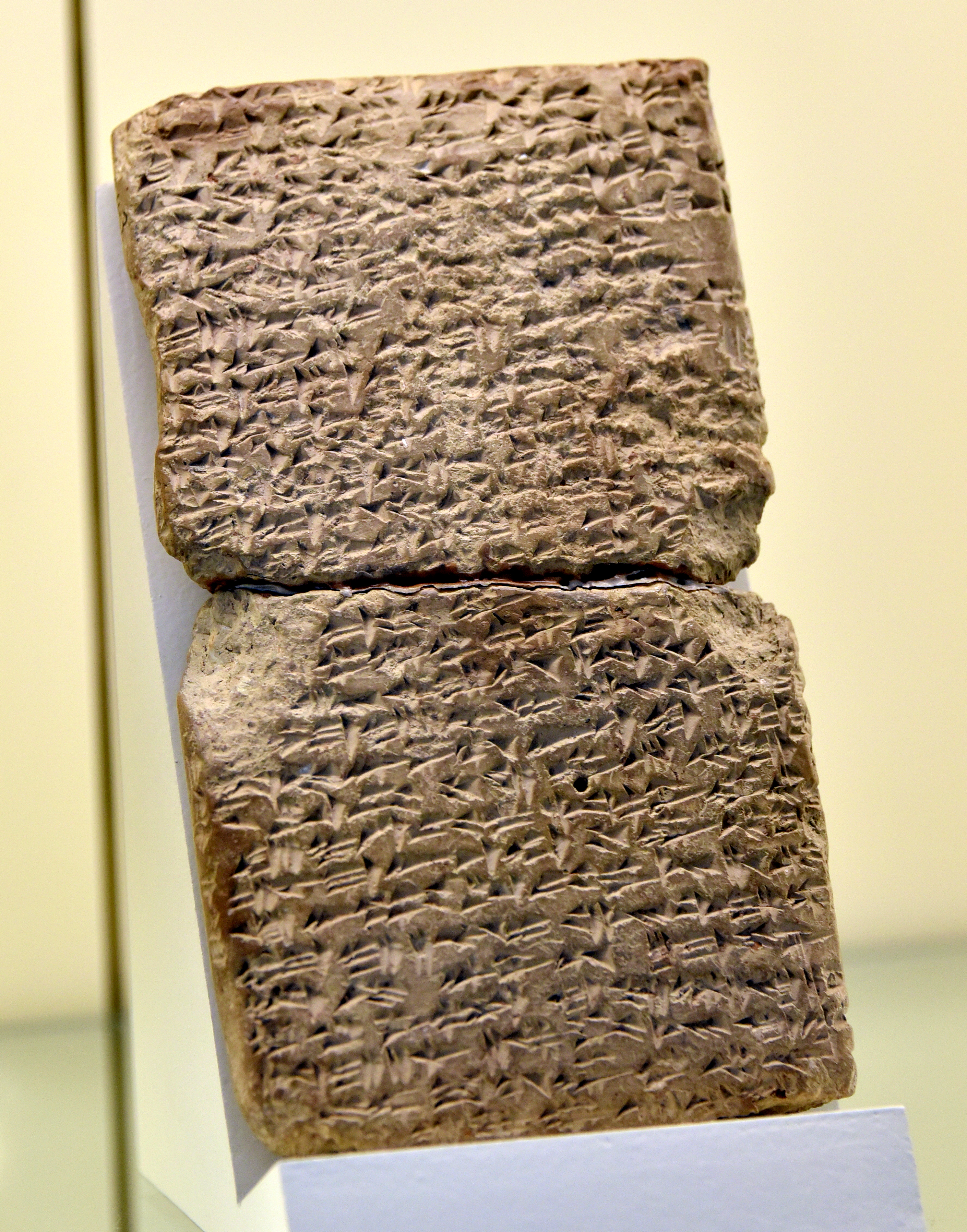
The Amarna Letters corpus was discovered beginning in 1887 AD by local villagers at Tell el-Amarna, the ancient Egyptian capital Akhetaten, in Upper Egypt. Among the roughly 382 cuneiform tablets recovered, six were written by Abdi-Heba, ruler of Urusalim (Jerusalem), to Pharaoh Amenhotep IV (Akhenaten), reigning approximately 1353–1336 BC. EA 286 is the most extensively studied of these dispatches. The tablets were distributed among several institutions; EA 286 is held in the Egyptian Museum, Cairo, while related letters reside in the Vorderasiatisches Museum, Berlin, and the British Museum, London. William Flinders Petrie and subsequent Egyptologists confirmed the archive's authenticity and Late Bronze Age date through stratigraphic and paleographic analysis conducted from 1888 AD onward. EA 286 is a baked clay tablet inscribed in Akkadian cuneiform, the diplomatic lingua franca of the ancient Near East during the fourteenth century BC. The text measures approximately 8 × 6 cm. Abdi-Heba appeals urgently to Pharaoh for Egyptian garrison troops, warning that the region is being destabilized by groups he calls the Ḫapiru—a term denoting socially marginal or displaced peoples whose precise relationship to the biblical Hebrews remains a subject of ongoing scholarly discussion. Critically, the letter names the city as Urusalim, rendering it the earliest known extra-biblical reference to Jerusalem. This predates the Israelite conquest narratives and the Davidic capture of the city recorded in 2 Samuel 5:6 by roughly three centuries. For biblical scholarship, EA 286 confirms that Jerusalem functioned as a recognized administrative center under Egyptian suzerainty before any Israelite settlement. This directly contextualizes references to Jebusite Jerusalem in Joshua 15:63 and Judges 1:21, as well as the enigmatic figure of Melchizedek, king of Salem, in Genesis 14:18. The letter's geopolitical anxieties—vassals appealing to a distant imperial power amid internal instability—illuminate the broader Canaanite political environment that biblical narratives presuppose. The Amarna archive as a whole continues to anchor scholarly reconstructions of Late Bronze Age Palestine. **Sources:** William L. Moran, *The Amarna Letters* (Johns Hopkins University Press, 1992); Anson F. Rainey, *The El-Amarna Correspondence*, 2 vols. (Brill, 2015); Na'aman, Nadav, "Canaan in the Second Millennium B.C.E.," *Collected Essays* (Eisenbrauns, 2005); Genesis 14:18; Joshua 10:1; 2 Samuel 5:6.
EA 286 is the earliest extra-biblical attestation of Jerusalem by name, anchoring the city's pre-Israelite political identity in Late Bronze Age Canaanite administration and providing direct archaeological context for biblical accounts of Jebusite Jerusalem.