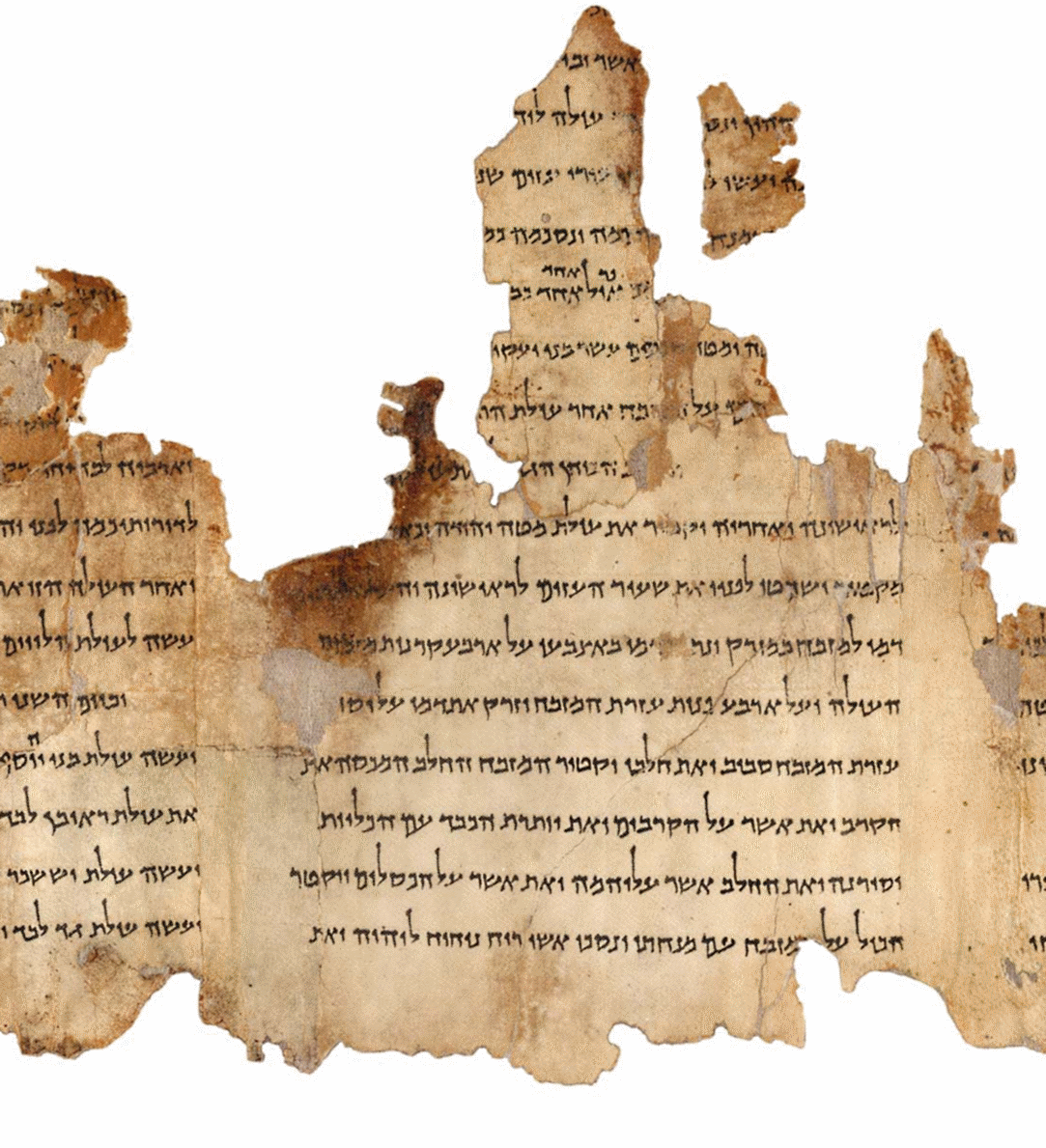
The Temple Scroll was acquired by Israeli archaeologist and general Yigael Yadin in 1967, following the Six-Day War, from an antiquities dealer who had obtained it from Kando (Khalil Iskander Shahin), the Bethlehem merchant who served as a primary conduit for Cave 11 material from Qumran. The scroll had likely been in private hands since its discovery in Cave 11 sometime around 1956, alongside other significant manuscripts. Yadin published the editio princeps in Hebrew in 1977, with an English edition following in 1983. The scroll is now housed at the Shrine of the Book, Israel Museum, Jerusalem, under the Israel Antiquities Authority. The scroll is composed of thin, remarkably well-preserved sheets of animal skin, extending approximately 8.75 meters in length across 66 columns of Hebrew text. Paleographic and radiocarbon analysis date the manuscript to the late second or early first century BC, though the composition it preserves is generally considered older. The text systematically reorganizes and supplements large portions of Exodus, Leviticus, Numbers, and Deuteronomy—rewriting them in direct divine first-person address—to produce a comprehensive temple-building program, festival calendar, purity legislation, and law of the king. The architectural specifications for an idealized three-court temple diverge substantially from both the Solomonic and Herodian models and draw heavily on passages such as Deuteronomy 12 and the Priestly festival calendars of Leviticus 23 and Numbers 28–29. For biblical scholarship, 11Q19 is significant on multiple levels. It demonstrates that Torah text was actively reinterpreted and expanded within Jewish communities of the late Second Temple period, offering insight into how Deuteronomic and Priestly material was read, harmonized, and applied to contemporary cultic concerns. The scroll's treatment of the law of the king (Deuteronomy 17:14–20) and its elaborate purity codes illuminate the legal diversity within pre-70 AD Judaism. Scholarly debate continues regarding the scroll's relationship to the Qumran community and to the broader phenomenon of rewritten scripture. **Sources:** Yigael Yadin, *The Temple Scroll*, 3 vols. (Israel Exploration Society, 1983); Lawrence H. Schiffman, *Reclaiming the Dead Sea Scrolls* (Jewish Publication Society, 1994); Johann Maier, *The Temple Scroll: An Introduction, Translation and Commentary* (JSOT Press, 1985); Deuteronomy 17:14–20; Leviticus 23:1–44.
At roughly 8.75 meters, 11Q19 is the longest surviving Dead Sea Scroll. Its systematic rewriting of Pentateuchal law into first-person divine speech illuminates late Second Temple legal interpretation and expectations surrounding temple worship, purity, and kingship.