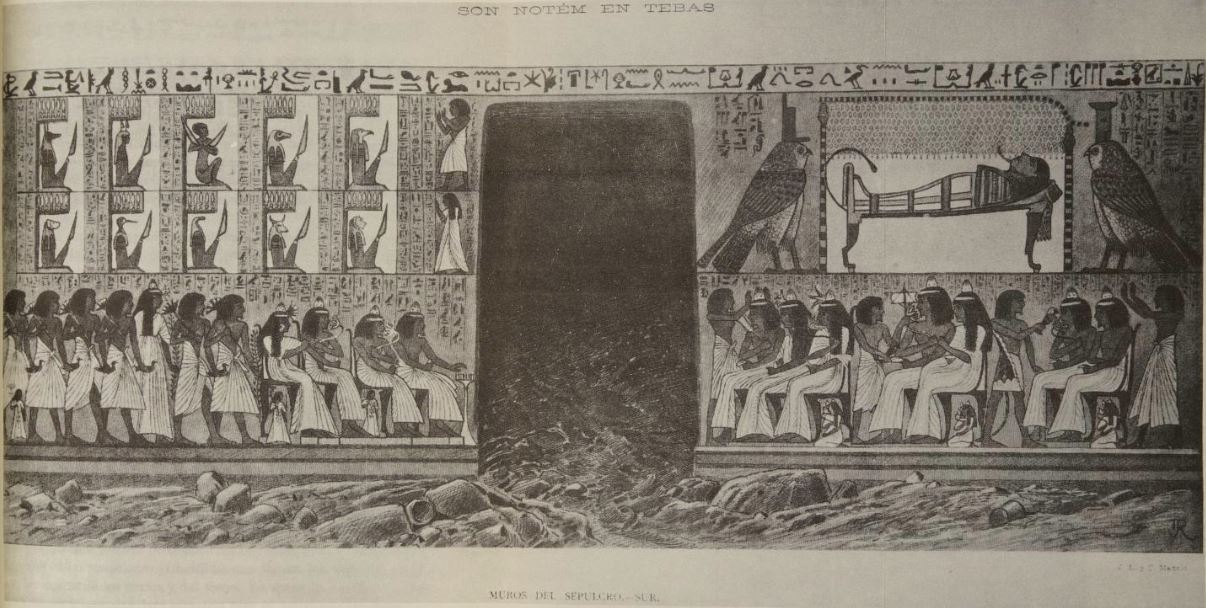
Tomb TT1, belonging to the royal necropolis workman Sennedjem and his family, was discovered intact on 31 January 1886 by Gaston Maspero's Egyptian Antiquities Service team at Deir el-Medina on the Luxor West Bank. The sealed burial chamber had remained undisturbed since approximately 1279–1213 BC, during the reigns of Seti I and Ramesses II. The excavation recovered twenty mummies alongside an extraordinary array of funerary goods, most of which entered the Egyptian Museum, Cairo, where the wooden door panel is catalogued as JE 27303 and painted furnishings occupy dedicated galleries. The burial chamber itself remains accessible in situ at the site. The tomb's vaulted burial chamber measures roughly 5.5 by 2.6 meters and is covered floor to ceiling with painted plaster scenes drawn from the Book of Gates and the Book of the Dead. Particularly prominent is the Field of Iaru (Aaru) sequence, depicting Sennedjem and his wife Iyneferti harvesting emmer wheat, plowing with oxen, and reaping flax under an idealized afterlife sky. These scenes reproduce, in an otherworldly register, the actual agricultural tasks documented in New Kingdom estate records. The hieroglyphic texts accompanying the vignettes cite Chapter 110 of the Book of the Dead. Tools, shabtis, and a painted wooden bed found within the chamber correlate directly with artifact classes known from settlement excavations at the Deir el-Medina village, extensively studied by Bernard Bruyère between 1922 and 1951. For biblical scholarship, TT1 contextualizes the material and conceptual environment described in Egyptian-setting passages of Genesis and Exodus. The agricultural technology depicted — irrigation-fed grain cultivation, forced or conscripted labor organization, linen production — corresponds to the subsistence and corvée systems referenced in Exodus 1:11 and Deuteronomy 11:10. The tomb's embalming equipment and mummy preparation parallel practices alluded to in Genesis 50:2. Scholarly analysis of Deir el-Medina's workforce documents a literate, semi-autonomous artisan community within the state apparatus, providing a realistic social model for skilled non-elite laborers in New Kingdom Egypt. **Sources:** Erik Hornung, *The Ancient Egyptian Books of the Afterlife*, trans. David Lorton (Cornell University Press, 1999); John Romer, *Ancient Lives: Daily Life in Egypt of the Pharaohs* (Holt, 1984); Bernard Bruyère, *Rapport sur les fouilles de Deir el Médineh (1935–1940)* (Institut Français d'Archéologie Orientale, 1952); Exodus 1:11; Genesis 50:2.
TT1 provides unparalleled visual documentation of New Kingdom funerary religion, agricultural technology, and artisan life at the height of Egyptian imperial power — the precise sociohistorical milieu against which scholars situate the biblical accounts of Israelite labor and Joseph's Egyptian sojourn.