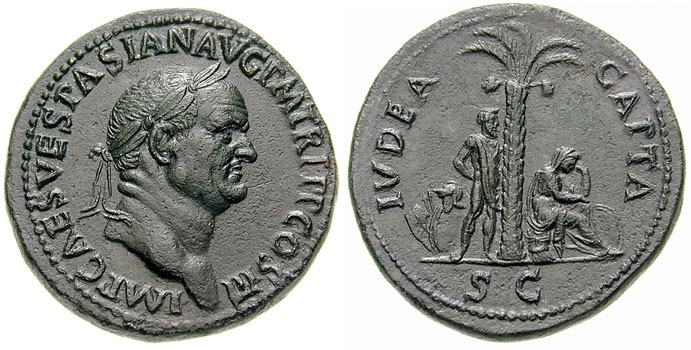
The Judaea Capta coinage was issued beginning in AD 71 under the emperor Vespasian (reigned AD 69–79) to celebrate the Roman suppression of the First Jewish Revolt and the destruction of Jerusalem in AD 70. The sestertius denomination, struck at the Rome mint, represents the most visually elaborate issue in the series. Surviving specimens are held in major institutional collections including the British Museum (Department of Coins and Medals), the American Numismatic Society (New York), the Bibliothèque nationale de France (Cabinet des Médailles, Paris), and the Israel Museum (Jerusalem), among others. The series was studied systematically by Harold Mattingly in his foundational work on Roman Imperial Coinage and has since been examined extensively by scholars including Henner von Hesberg and Ya'akov Meshorer. The sestertius measures approximately 33–35 mm in diameter and was struck in orichalcum (a zinc-brass alloy). The obverse bears the laureate portrait of Vespasian with the legend IMP CAES VESPASIAN AVG. The reverse presents the canonical Judaea Capta iconography: a trophy flanked by a standing Roman soldier and a seated, mourning female figure representing the captive province of Judea, accompanied by the legend IVDAEA CAPTA and SC (Senatus Consulto). This imagery was reproduced across multiple denominations and constitutes one of the most sustained Roman commemorative coin programs of the first century AD. For biblical scholarship, these coins provide independent, contemporary material attestation of the Roman destruction of Jerusalem prophesied in the Synoptic Gospels (Matthew 24:1–2; Mark 13:1–2; Luke 21:20–24). They also illuminate the broader Flavian political context in which early Christian communities operated and in which texts such as the Gospel of Luke and the book of Revelation were composed or circulated. The coins document how Roman imperial culture framed the Judean defeat, a framing that shaped the geopolitical environment of nascent Christianity and Second Temple Judaism's aftermath. The Judaea Capta series remains a primary source in both Roman numismatic studies and the archaeology of the Jewish-Roman wars. **Sources:** Harold Mattingly and Edward Sydenham, *Roman Imperial Coinage, Vol. II: Vespasian to Hadrian* (Spink, 1926); Ya'akov Meshorer, *A Treasury of Jewish Coins* (Yad Ben-Zvi Press, 2001); Henner von Hesberg and Silvio Panciera, *Das Mausoleum des Augustus* (Bayerische Akademie, 1994); Luke 21:20–24; Matthew 24:1–2.
The Judaea Capta sestertius provides direct numismatic confirmation of Rome's AD 70 conquest of Jerusalem, offering material corroboration for the Gospel accounts of the Temple's destruction and contextualizing the Flavian commemoration of that event in imperial propaganda.