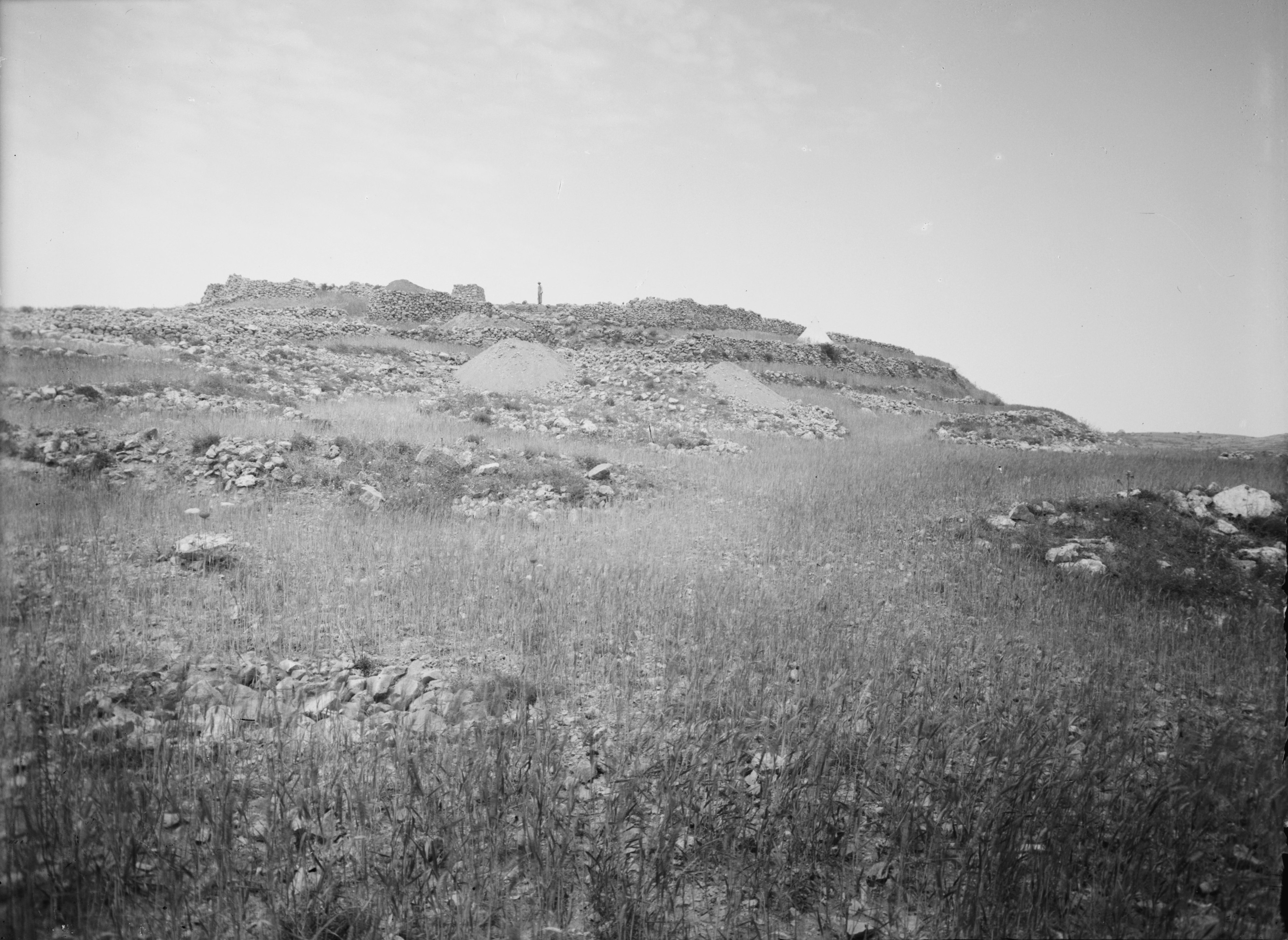
The seal was recovered during systematic excavations at Tell en-Nasbeh, widely identified with ancient Mizpah, conducted between 1926 and 1935 under the direction of William Frederic Badè on behalf of the Pacific School of Religion. The site lies approximately 12 kilometers north of Jerusalem in the Benjaminite hill country. Following Badè's death in 1936, Chester C. McCown oversaw publication of the excavation results. The seal entered the scholarly record as part of the Tell en-Nasbeh corpus and is associated with the Harvard Semitic Museum collection. The seal is carved from black jasper and measures approximately 25 millimeters in length in an elongated oval form typical of late Iron Age IIB–IIC Judahite administrative seals. It bears a two-line Hebrew inscription reading lyznyhw / 'bd hmlk — "Belonging to Yaazaniah, servant of the king" — flanked by a fighting-cock motif, one of the earliest depictions of a rooster on a Hebrew seal. The title 'eved ha-melek (servant of the king) was a recognized administrative rank in the Judahite bureaucracy, attested across multiple seal impressions from the late monarchic period. The seal's significance for biblical study lies in its potential correspondence to Yaazaniah son of the Maacathite, one of the Judahite military commanders who approached Gedaliah at Mizpah following the Babylonian destruction of Jerusalem, as recorded in 2 Kings 25:23 and the parallel passage in Jeremiah 40:8. The find-spot at Mizpah strengthens the topographic plausibility of this identification, though scholarly consensus treats it as suggestive rather than certain. The seal nonetheless corroborates that Mizpah functioned as a genuine administrative center in the late seventh and early sixth centuries BC, consistent with its biblical role as the seat of Gedaliah's governorship. **Sources:** William F. Badè and Chester C. McCown, *Tell en-Nasbeh I: Archaeological and Historical Results* (Palestine Institute, 1947); Nahman Avigad and Benjamin Sass, *Corpus of West Semitic Stamp Seals* (Israel Academy of Sciences and Humanities, 1997); 2 Kings 25:23; Jeremiah 40:8.
This inscribed jasper seal from Mizpah carries the name Yaazaniah alongside the title 'servant of the king,' offering a rare potential onomastic link between an archaeological object and a named individual mentioned in the biblical account of Judah's final days.