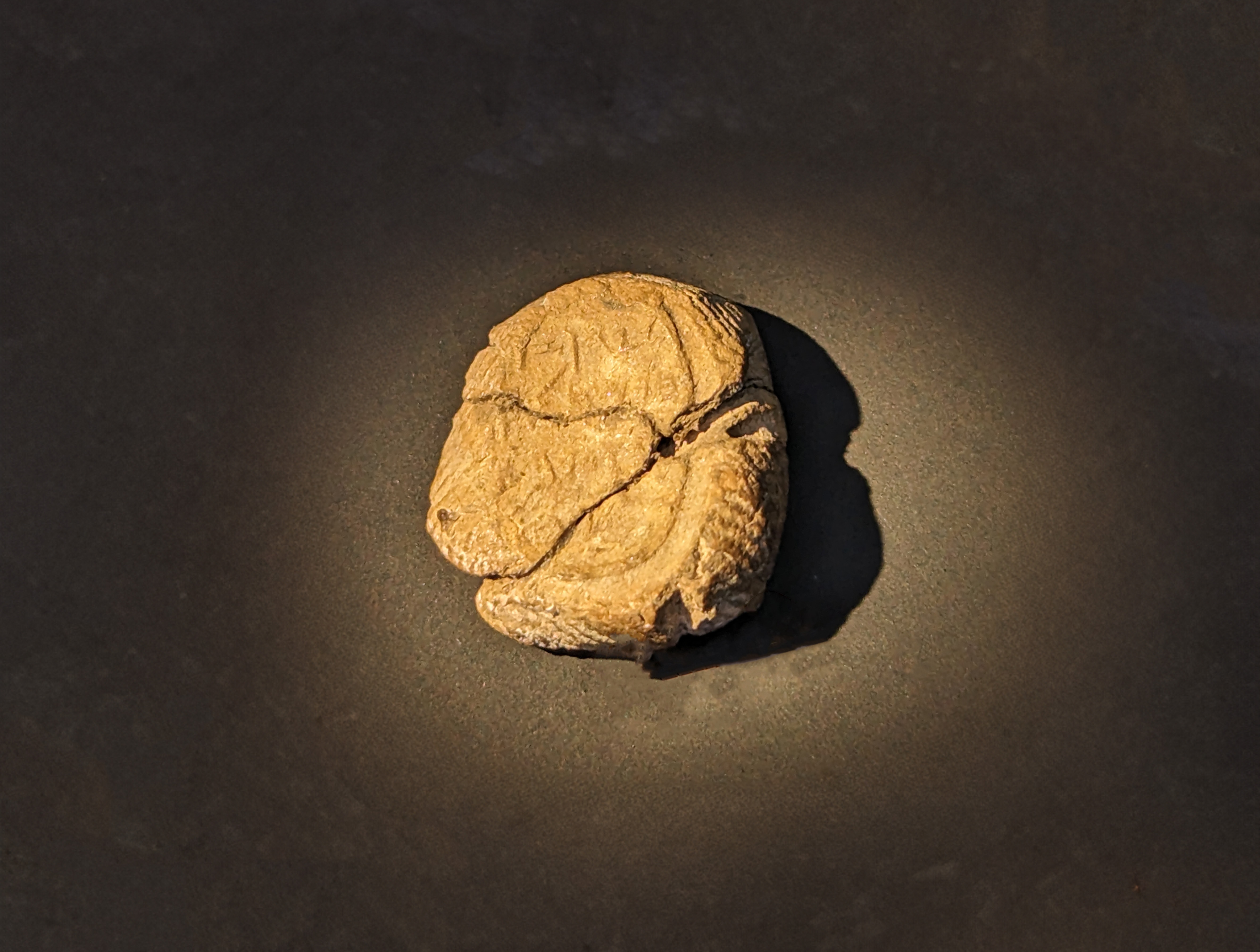
The bulla of Yehozarah son of Hilkiah is a small fired clay seal impression bearing a Hebrew inscription identifying its owner as a royal official in the court of King Hezekiah of Judah (r. c. 727–698 BC). The inscription reads, in paleo-Hebrew script, 'belonging to Yehozarah son of Hilkiah, servant of Hezekiah,' with 'servant' (eved) functioning here as a technical administrative title denoting a high-ranking palace official rather than a menial subordinate. The bulla was reportedly retrieved from the Lachish region, a major Judahite administrative center well attested in both the biblical record and the archaeological record, though its precise excavation context is uncertain, as it entered the market through antiquities channels rather than a controlled dig. The seal itself belongs to a well-documented corpus of Judahite administrative bullae from the late Iron Age IIB–IIC period, characterized by their ovoid shape, two-line Hebrew inscription, and occasional iconographic devices. The names Yehozarah and Hilkiah are both theophoric Hebrew names consistent with Judahite onomastic patterns of the 8th–7th centuries BC. No individual named Yehozarah son of Hilkiah appears by that combination in the biblical text, though a Hilkiah is mentioned as a court official in 2 Kings 18:18 and 18:26, serving during Hezekiah's confrontation with the Assyrian Rabshakeh. The bulla materially attests the administrative infrastructure of the Judahite monarchy during the period described in 2 Kings 18–19 and 2 Chronicles 32, without establishing a direct identification with any named biblical figure. Sources: Israel Museum Jerusalem; N. Avigad & B. Sass, Corpus of West Semitic Stamp Seals (1997); Bulletin of the American Schools of Oriental Research.
This bulla provides epigraphic confirmation of the Judahite royal bureaucracy operating under Hezekiah's name during the late 8th century BC, the same administrative world reflected in the biblical accounts of Hezekiah's reign and the Assyrian crisis. It contributes to the growing corpus of seal impressions that document palace administration in Iron Age Judah without requiring identification with any specific biblical character.