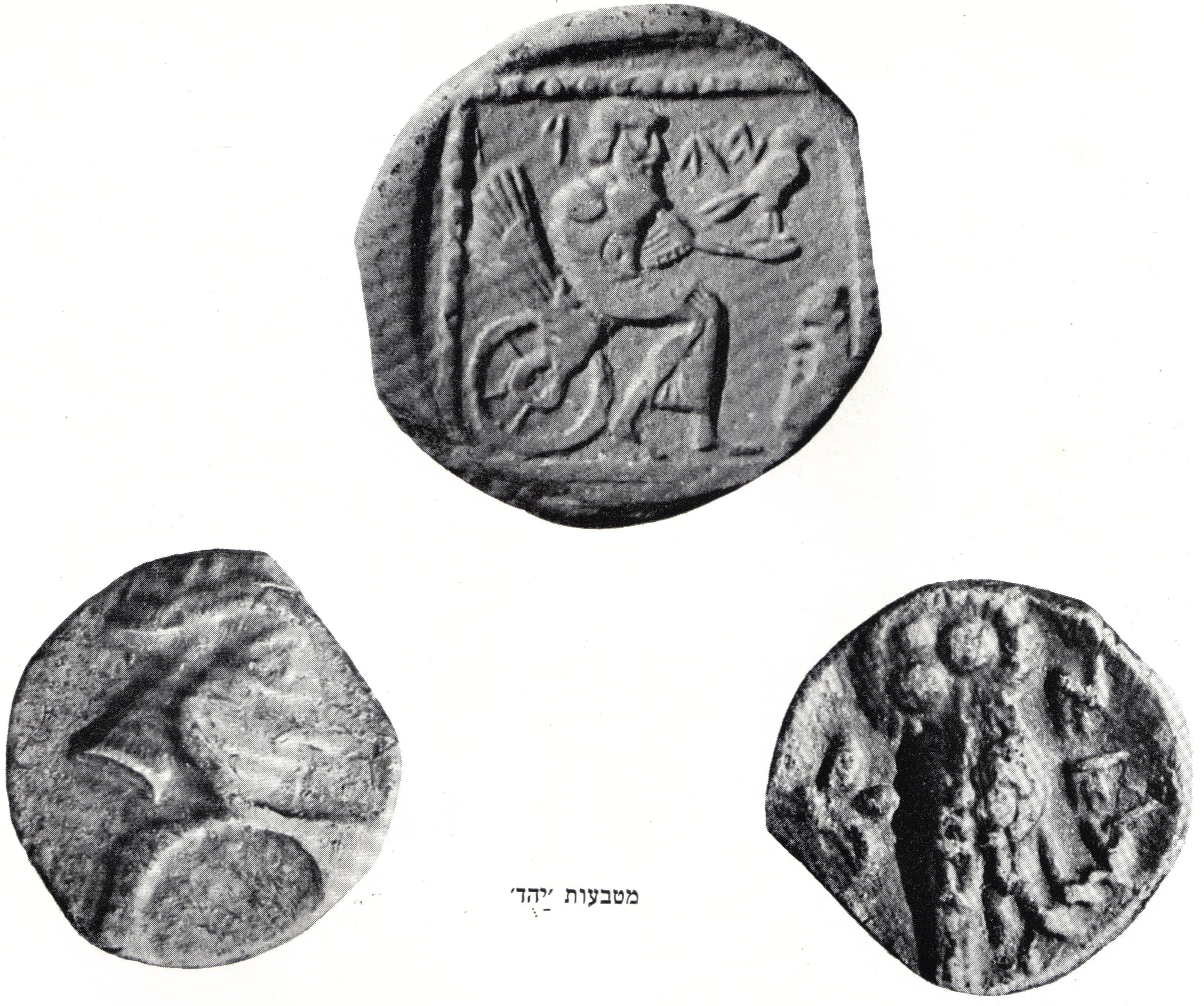
The Yehud coins are a series of small silver issues minted within the Persian administrative province of Yehud—the post-exilic territory of Judah—during roughly the fourth century BC, with some scholars extending the series into the late fifth century. Struck predominantly as tiny fractional denominations (obols and half-obols), they are among the earliest coins produced in the southern Levant. The coins bear the Aramaic inscription YHD (יהד), the official provincial designation attested in Persian-era administrative documents, and some issues add a personal name, likely that of a governor or high priest. Iconography varies: certain specimens display a human head, a falcon, a lily, or an owl clearly derivative of Athenian coinage, reflecting the broader commercial networks of the eastern Mediterranean under Achaemenid oversight. Most examples have surfaced through controlled excavations in and around Jerusalem and through the antiquities market, making precise find-spot data uneven for a portion of the corpus. The coins intersect the biblical record in a limited but meaningful way. The books of Ezra and Nehemiah describe Yehud as a functioning Persian province with appointed governors holding royal warrants (Ezra 1:1–4; Nehemiah 2:1–8). The YHD inscription on the coins independently confirms that 'Yehud' was the formal provincial name in Aramaic—the administrative lingua franca of the empire—corroborating the administrative vocabulary embedded in those biblical texts. The coins do not verify the specific individuals or episodes narrated, but they materially attest to a monetized, bureaucratically organized entity in post-exilic Judah consistent with the broader Achaemenid provincial system the biblical texts presuppose. Sources: Israel Museum (Jerusalem, coin collection); Leo Mildenberg, 'Yehud: A Preliminary Study of the Provincial Coinage of Judaea,' in Greek Numismatics and Archaeology (1977); David Vanderhooft and Wouter Horowitz, 'The Cuneiform Inscription from Tell en-Nasbeh,' Tel Aviv (2002); Oded Lipschits and David Vanderhooft, The Yehud Stamp Impressions (Eisenbrauns, 2011).
The YHD inscription on these coins independently verifies the Aramaic provincial name 'Yehud' used in Ezra and Nehemiah, confirming that post-exilic Judah functioned as a recognized, monetized administrative unit within the Achaemenid empire. This physical evidence anchors the socio-political framework those biblical books describe within documented Persian provincial practice.