Dirk Willems
Dirk Willemszoon
Life and Ministry
Dirk Willems was born in the early sixteenth century in Asperen, a small town in the polder country of South Holland, and was rebaptized as a young man in the Anabaptist congregation that had survived the Münster catastrophe of 1535 and the subsequent Habsburg persecution. He was caught up in the Spanish Inquisition's renewed campaign against the Dutch Anabaptists in the 1560s, the same campaign that drove William of Orange's revolt and would in time produce the Dutch Republic. Willems was arrested at Asperen sometime in early 1569 and held in a converted upper room above the town palace.
Circumstances of Death
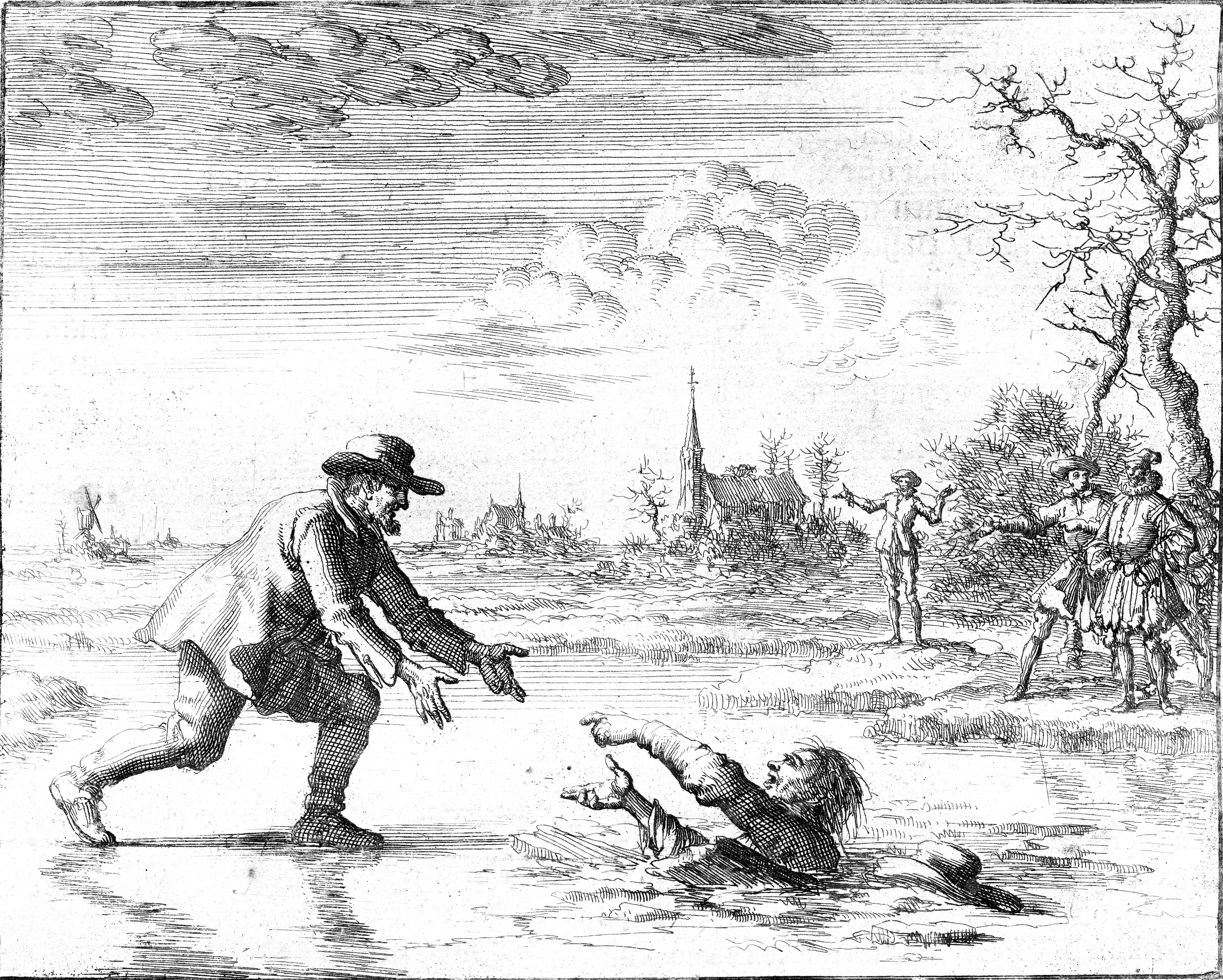
Willems escaped from the upper room by a knotted rope made from his bedclothes and ran across the frozen moat in the deep cold of late winter. The thief-catcher — the man hired by the magistrates to recover escaped prisoners — gave chase. The catcher, heavier than Willems, broke through the ice in mid-pond and went under, calling for help. Willems, who had reached the far side, turned back across the ice, lay flat to distribute his weight, and pulled the catcher out of the water. The catcher, when he had recovered, prepared to release Willems on the spot — but the burgomaster, who had come up at the noise, ordered him to make the arrest. Willems was returned to his cell, sentenced for "anabaptism, escape from prison, and lewdness" (the standard catch-all), and burned at the stake on May 16, 1569 outside the wall of Asperen. The wind, by the eyewitness account preserved in the Martyrs Mirror, blew the flames sideways and prolonged his agony for upwards of an hour.
Legacy
The 1685 Martyrs Mirror engraving by Jan Luyken — Willems on his knees on the ice, reaching to pull the catcher from the freezing water — is one of the most famous images in the history of Anabaptist imagination and one of the quietest theological statements ever drawn. The story has been retold in Mennonite and Brethren households for four centuries as a single answer to the question of what nonresistant Christianity looks like in a moment of clear advantage. The original Asperen courthouse was demolished in the nineteenth century; the spot is marked with a plaque.
Sources
Thieleman J. van Braght, Martyrs Mirror (1660; English translation 1837), entry "Dirck Willemszoon"; Jan Luyken, engraving from the 1685 edition; municipal records of Asperen, May 1569.