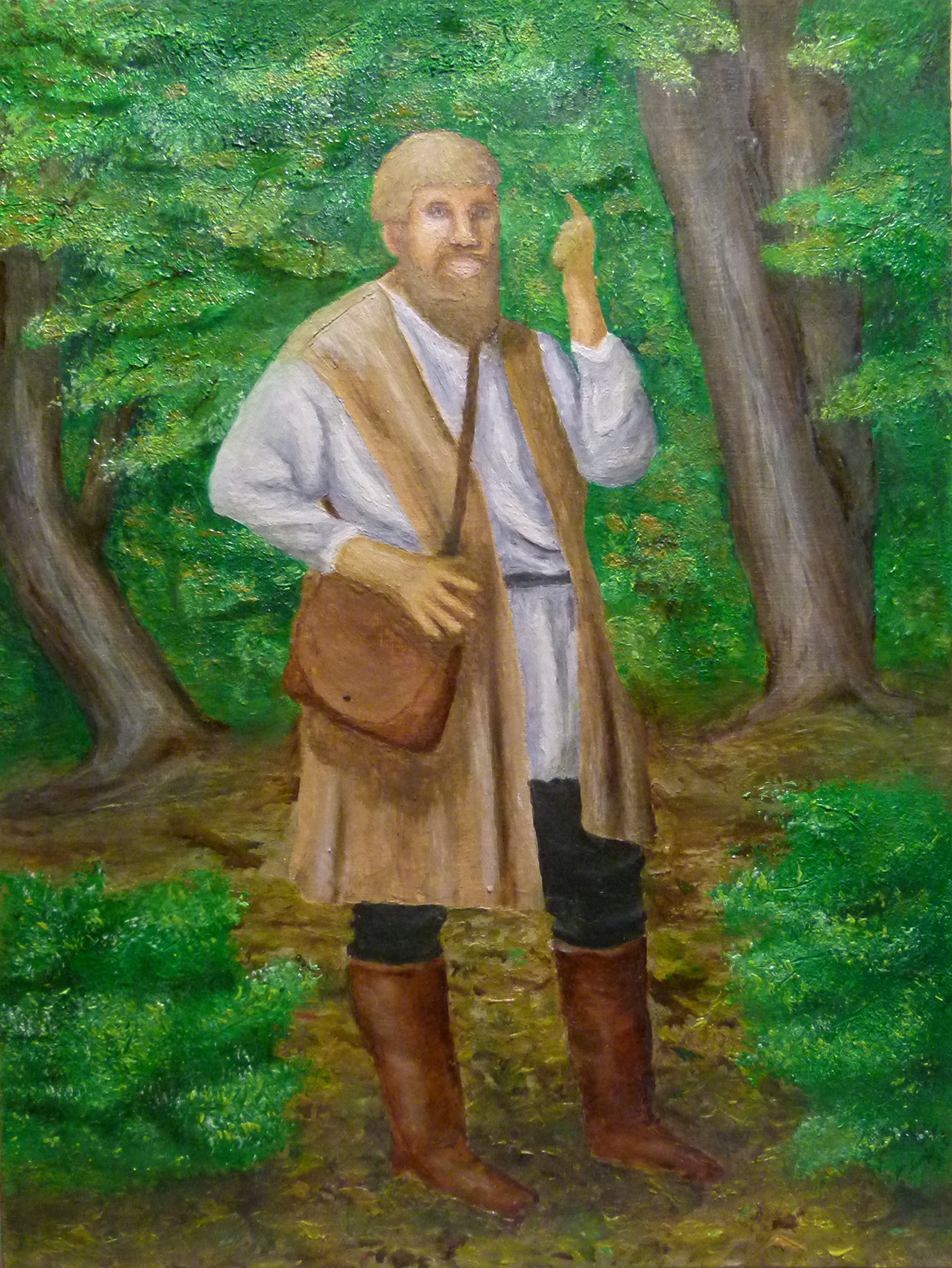
Michael Sattler
Michael of Staufen
Life and Ministry
Michael Sattler was born around 1490 in Staufen im Breisgau and entered the Benedictine monastery of Saint Peter's in the Black Forest, where he rose to be prior. The peasant uprisings of 1524–25 disrupted his monastery; in their wake Sattler abandoned monastic life, married a former Beguine named Margaretha, and joined the Swiss Brethren in Zurich. After a brief imprisonment there he settled in Strasbourg in 1526, where he debated with Bucer and Capito on the question of believer's baptism. From Strasbourg he traveled to the Württemberg foothills and gathered the Brethren in February 1527 at the village of Schleitheim, where over several days he drafted what became the foundational Anabaptist confession — the Schleitheim Articles, on baptism, the ban, the Lord's Supper, separation from the world, the office of pastor, the sword, and the oath.
Circumstances of Death
Sattler and his wife Margaretha were arrested at Horb am Neckar in April 1527 by the Catholic territorial authority of Austria. He was tried at Rottenburg in May before a panel of judges with nine charges against him, the most provocative being that he had taught that Christians should refuse military service against the Turks. His final speech at trial — "If the Turks should come, we ought not to resist them. For it is written, thou shalt not kill" — has been preserved in eyewitness records. He was sentenced to a death calculated to make recantation seem desirable: his tongue would be cut out, his body torn with red-hot pincers six times in the public squares of the town, and finally he would be burned at the stake. On May 20, 1527, Sattler was led to the place of execution outside the walls of Rottenburg and the sentence carried out in full. His last cry, after the third application of the pincers, was a prayer for the executioners. Margaretha was drowned eight days later.
Legacy
The Schleitheim Confession became the doctrinal charter of the Swiss Brethren and the Mennonites; its seven articles still define what makes a church Anabaptist by historic measure. Sattler's death — the calculated cruelty of the sentence, the tongue cut out, the public march through the town squares — was the first major Anabaptist passion narrative and circulated through the Brethren in manuscript copies for the rest of the sixteenth century. John Howard Yoder, the late twentieth-century theologian who recovered Anabaptist theology for the broader Christian conversation, treated Sattler's Schleitheim text and his death together as the founding moment of pacifist Christianity in Europe.
Sources
Klaus Deppermann, ed., Quellen zur Geschichte der Täufer im Elsaß (1959); John Howard Yoder, The Legacy of Michael Sattler (1973); Schleitheim Confession, February 1527; trial records of Rottenburg, May 1527.