Felix Manz
Felix Mantz
Life and Ministry
Felix Manz was born around 1498 in Zurich, the illegitimate son of a canon of the Grossmünster, and educated in Greek, Hebrew, and Latin at his father's expense. He was among the first young men drawn into Ulrich Zwingli's reforming circle in the early 1520s and led, with Conrad Grebel, the Bible study that met in his mother's house. By the autumn of 1524 the Manz–Grebel circle had concluded that infant baptism could not be defended from the New Testament and that the Reformation as Zwingli was conducting it would not go far enough. On January 21, 1525, in Manz's mother's house, Grebel rebaptized George Blaurock and Blaurock then rebaptized the others — the founding act of the Anabaptist movement.
Circumstances of Death
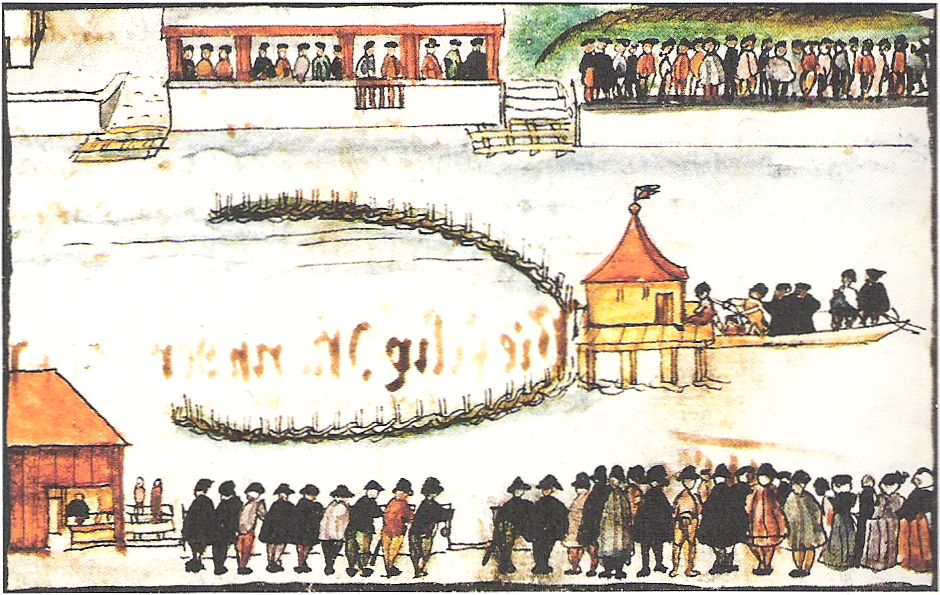
The Zurich council, having three times debated and voted against the Anabaptists, made rebaptism a capital offense in March 1526 by an explicit statute. Manz was arrested for the third and final time in December 1526, refused to recant or to leave Zurich, and was condemned to death. The form of execution chosen by the council was deliberately mocking — drowning by the third baptism, "let him have what he wanted." On the afternoon of January 5, 1527, Manz was rowed from the fish market into the middle of the Limmat River, his hands tied behind his knees and a stick passed through, and pushed into the water. He was sung into death by his mother and brother shouting encouragement from the bank, and by his own voice singing "In manus tuas, Domine, commendo spiritum meum." He was the first Protestant martyr executed by Protestant authority in the Reformation.
Legacy
Manz was the first of perhaps four thousand Anabaptists who would die in the next century at the hands of Reformed, Lutheran, and Catholic governments alike. The Schleitheim Confession that Michael Sattler would draft four months later took Manz's death as the founding witness. The Anabaptist tradition that survived persecution — the Mennonites, the Hutterites, the Amish, the Swiss Brethren — descends through the same circles. The Limmat River drowning gave the anti-Anabaptist phrase "third baptism" to the German theological vocabulary. The plaque set into the wall of the Schipfe quay in Zurich in 2004 remembers him at the spot.
Sources
Heinold Fast, ed., Quellen zur Geschichte der Täufer in der Schweiz (1973); William R. Estep, The Anabaptist Story (3rd ed., 1996); George H. Williams, The Radical Reformation (3rd ed., 1992); records of the Zurich council, January 5, 1527.