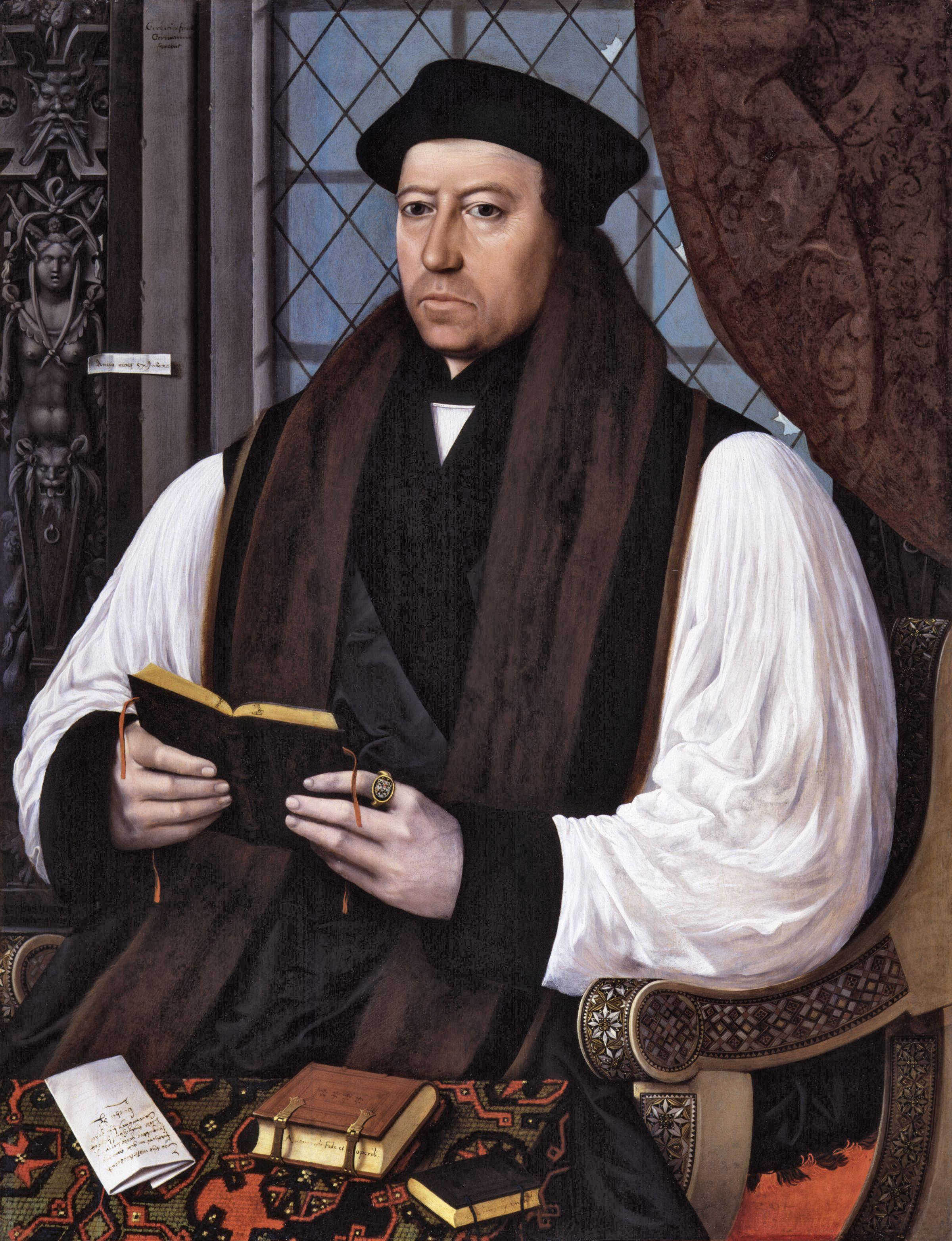
Thomas Cranmer
Archbishop Cranmer
Life and Ministry
Thomas Cranmer was born in Aslockton in Nottinghamshire in 1489, took his degrees at Jesus College Cambridge, and was an obscure don until Henry VIII's "Great Matter" — the search for a way to dissolve his marriage to Catherine of Aragon — brought Cranmer to the king's notice in 1529. Henry made him Archbishop of Canterbury in 1533, and Cranmer for the next twenty years gave the English Reformation its prayer book, its homilies, and its constitutional shape. The first Edwardian Prayer Book (1549) and the much more thoroughly Reformed second Edwardian Prayer Book (1552) are his work; the Forty-two Articles of 1553, the basis of the later Thirty-nine Articles, are his work. He was arrested within weeks of Mary I's accession, deprived of his see in late 1554, and held for two and a half years.
Circumstances of Death
The Marian government wanted Cranmer's recantation more than his death — a recantation by the Archbishop who had given England the Reformed Prayer Book would be the single most damaging blow to the Protestant cause that could be dealt. Under prolonged psychological pressure Cranmer signed five successive recantations, each more sweeping than the last, in the months before his execution. Mary, having extracted what she wanted, refused to commute his sentence. On the morning of March 21, 1556, he was led to the University Church of St Mary the Virgin in Oxford and asked to read aloud a final, sixth recantation in front of the assembled university. Cranmer, having decided the night before what he would do, instead announced from the pulpit that he renounced his recantations as written from fear of death and that the hand which had signed them should burn first. He was rushed from the church to the same ditch where Latimer and Ridley had died five months before, and as the fire was lit he held his right hand into the flames and held it there until it was charred away, repeating "this hand hath offended."
Legacy
Cranmer's reversal at the stake — the moment that saved his name and stripped the queen's government of the recantation it had paid so dearly to obtain — became one of the most retold scenes in English Protestant memory. The Prayer Book of 1552, restored under Elizabeth in lightly revised form in 1559, became the central liturgical text of the Church of England for four centuries and the parent of the Anglican prayer-book tradition across the Communion. His prose — the General Confession, the Collect for Purity, the Prayer of Humble Access, the great phrase "from all evil and mischief" — entered the English language alongside Tyndale's. Diarmaid MacCulloch's modern biography (1996) treats him as a man whose final five-minute speech redeems the long failure that preceded it.
Sources
John Foxe, Acts and Monuments (1563); Thomas Cranmer, Works (Parker Society, 2 vols, 1844–46); Diarmaid MacCulloch, Thomas Cranmer: A Life (Yale, 1996).