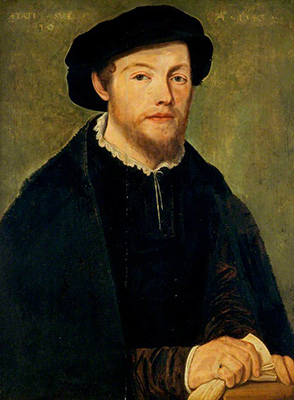
George Wishart
Wishart of Pittarrow
Life and Ministry
George Wishart was born around 1513 to a family of Mearns lairds, took an arts degree at King's College Aberdeen, and was appointed schoolmaster at Montrose, where in 1538 he was charged with heresy for teaching his pupils to read the Greek New Testament directly. He fled first to England and then to the continent, spending time in Cambridge among the early English reformers, in Switzerland with the Reformed churches, and in Germany under Lutheran influence. Returning to Scotland in 1543 he became the most effective itinerant preacher of the early Scottish Reformation, traveling between Dundee, Montrose, Perth, and Edinburgh under heavy threat. He was tutor to a young John Knox during this period; Knox carried a two-handed sword as Wishart's bodyguard.
Circumstances of Death
Wishart was arrested in January 1546 at Ormiston and handed over to Cardinal David Beaton, the archbishop of St Andrews, who had hunted him for two years. The trial was held at St Andrews Cathedral on February 28; the verdict of heresy was given the same day. Wishart was led to the stake on the morning of March 1, in a square built directly under the windows of Beaton's castle so that the cardinal might watch the burning from his bedroom. The hangman, weeping, asked his forgiveness. Wishart kissed him on the cheek. He was hanged from a cross-piece above the pyre, and the wood was lit. As the smoke rose he was reported to call out, "This flame hath scorched my body, yet hath it not daunted my spirit; he who looks down so proudly from yonder window shall, within few days, lie in the same as ignominiously as he is now seen proudly to rest himself."
Legacy
Cardinal Beaton was assassinated at his castle three months later, on May 29, 1546, by a band of Fife lairds — including some of Wishart's friends — and his body was hung in the same square where the burning had taken place. Knox dated his own conversion from his time as Wishart's protector and treated Wishart's death as the moment at which the Scottish Reformation became inevitable. Wishart's translation of the First Helvetic Confession was the first systematic Reformed confession printed in Scots English. The Scottish Reformation parliament met within fourteen years of his burning.
Sources
John Foxe, Acts and Monuments (1563); John Knox, History of the Reformation in Scotland (1559–66); Charles Rogers, Life of George Wishart (1876); Martin Dotterweich, ed., New Perspectives on the Scottish Reformation (2010).